




For many buyers, the real cost of an EV is not the number on the invoice. It is the number that remains after charging, insurance, depreciation, and resale have all taken their turn. That is why Tesla vs BYD ownership cost is a more useful question than simple list price.
BYD often looks cheaper at the point of purchase, but Tesla can still make a serious long-term cost case in markets where charging convenience, software maturity, and resale confidence carry real weight. The cheaper long-term choice depends on where you live, which models you are comparing, how you charge, how long you keep the car, and what the used market looks like when you sell. The cheapest EV to buy is not always the cheapest EV to own.
Tesla vs BYD Ownership Cost: What Really Matters?
A serious ownership-cost comparison has to go beyond sticker price.
The obvious items are purchase price, incentives, charging, maintenance, tires, insurance, and repairs. The less obvious ones are software support, service access, battery warranty confidence, depreciation, and resale value. Those hidden factors are often what separate a car that looks cheap on day one from a car that still feels sensible three or four years later. Some of the biggest long-term expenses are not obvious at the showroom, which is why we covered the broader hidden costs of EV ownership.
Ownership cost is not a single number. It is a stack of predictable expenses plus a smaller stack of market-dependent risks. That is why two buyers can own similarly priced EVs and still come away with very different cost stories.
Purchase Price and Incentives
This is where BYD often makes its strongest first impression.
In many markets, BYD competes aggressively on price and standard equipment. Tesla pricing can move more sharply by trim, region, temporary discounts, and financing offers. Incentives complicate the picture further, because government support can shift the comparison hard in either direction depending on local rules and model eligibility. Official regional pricing and warranty pages matter here because incentives, trim structure, and market positioning can change the comparison more quickly than many buyers expect.
That means BYD may be the easier answer for buyers focused on lower upfront cost, while Tesla may still look competitive where incentives, leasing terms, or stronger resale confidence narrow the gap. There is no honest global price verdict here. Buyers should verify current Tesla pricing, local BYD pricing, and local EV incentives before treating any comparison as final.
Charging Costs: Home Charging, Public Charging and Fast Charging
Charging cost depends more on electricity prices and charging behavior than on brand alone.
If you charge mostly at home on a favorable tariff, the cost gap between Tesla and BYD ownership can be smaller than many buyers expect. If you rely heavily on public fast charging, charging friction becomes part of the ownership bill, which is where Tesla’s ecosystem can matter more than a simple electricity-cost comparison suggests. DOE guidance is clear that EV fueling cost depends on where and how charging happens, while the IEA’s 2025 charging outlook shows how uneven charging conditions can still be across markets.
This is where Tesla can claw back some of its higher purchase price in certain regions. Its charging ecosystem and software integration can reduce hassle, especially on longer trips or for buyers without ideal home charging. BYD ownership cost depends more on local charging access, vehicle efficiency, and how good third-party charging actually is where the owner lives. Charging cost depends heavily on where and how the car is charged; our guide to EV charging costs explains the basics, while EV charging experience looks at the convenience side.
For many households, charging behavior matters more than vehicle brand. A Tesla owner who charges mostly at expensive public fast chargers may spend more than a BYD owner who charges overnight at home.
Likewise, a BYD owner with convenient home charging may see very low operating costs despite having less access to a dedicated charging ecosystem.
The ownership-cost conversation often becomes less about Tesla versus BYD and more about home charging versus public charging.
Maintenance and Repair Costs
Routine maintenance is one of the easier parts of the EV case.
Both Tesla and BYD avoid oil changes, exhaust-system work, and many of the service items that make combustion-car ownership steadily annoying. DOE guidance notes that battery-electric vehicles generally need less maintenance because they have fewer moving parts and avoid many traditional engine-related service needs.
Where the comparison gets less tidy is repairs. Real-world repair cost depends on parts availability, labor rates, diagnostics, service-network maturity, and warranty handling. Tesla has the advantage of longer ownership history in many markets, which can make the repair conversation feel less mysterious. BYD’s repair story depends more heavily on how mature its regional dealer and service support has become. A reliable EV with weak parts support can still become expensive, or at least exhausting, to own. For a broader breakdown of routine service items, see our guide to EV maintenance costs.
The difference becomes larger when unexpected repairs enter the equation.
Parts availability, service appointment delays, and diagnostic complexity can affect both cost and ownership satisfaction. A repair that takes weeks instead of days may not change the invoice dramatically, but it still increases the real cost of ownership.
For many long-term owners, convenience is part of the ownership-cost equation.
Tires, Insurance and Everyday Running Costs
This is where ownership gets less glamorous and more real.
EVs are heavy and deliver torque instantly, which can mean faster tire wear than buyers expect. Performance-oriented Tesla trims may cost more on tires, while some BYD models may be cheaper to run if they use smaller wheels, more modest outputs, or less expensive tire sizes. That is not a badge verdict. It is a trim-and-use verdict.
Insurance is even messier. Premiums vary by country, provider, repair cost, parts pricing, safety data, and model familiarity. Tesla insurance can be expensive in some markets because insurers worry about repair bills and parts pricing. BYD insurance depends more on how familiar the repair ecosystem is locally. This is not a section for fake global averages. Buyers need quotes in their own market, for their own trim, before pretending the answer is obvious.
Battery Life and Warranty Confidence
Battery confidence is one of the biggest hidden ownership-cost variables.
It affects not only long-term usability, but also resale value, used-buyer trust, and the owner’s willingness to keep the car beyond the finance period. Tesla benefits from a very large real-world ownership base and clearly published warranty support. Tesla’s official support pages show battery and drive-unit coverage of up to eight years, with model-specific mileage limits and capacity-retention terms. BYD UK’s warranty policy shows six years of basic cover and eight years of battery cover, while BYD Europe’s Blade Battery materials highlight eight years or 250,000 km and a 70% state-of-health threshold for covered packs in that region. Terms still vary by market and model, so buyers need to check the exact local page.
Battery health is central to long-term value, so buyers should understand how long EV batteries really last and how EV battery degradation affects usable range. DOE resources help frame the durability side, while BYD’s own battery messaging and Tesla’s warranty support show how central battery trust is to both brands’ ownership story.
Software, Charging Ecosystem and Convenience Costs
Software has economic value, even if it never appears on an invoice.
A car that routes well, updates reliably, and still feels modern after several years can be easier to live with and easier to sell. That is one reason Tesla can remain competitive on long-term ownership cost. Its software-first identity, OTA reputation, and charging integration can reduce friction in ways that do not show up neatly in a spreadsheet.
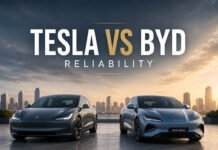
BYD can still make a strong value case here, but the software experience varies more by model and region. Some BYD vehicles offer strong equipment value, but buyers should still check local software polish, update support, and charging integration rather than assuming the ownership experience will feel equally mature everywhere. Software and ownership trust are also part of long-term reliability, which we explored in our Tesla vs BYD reliability comparison.
Depreciation and Resale Value
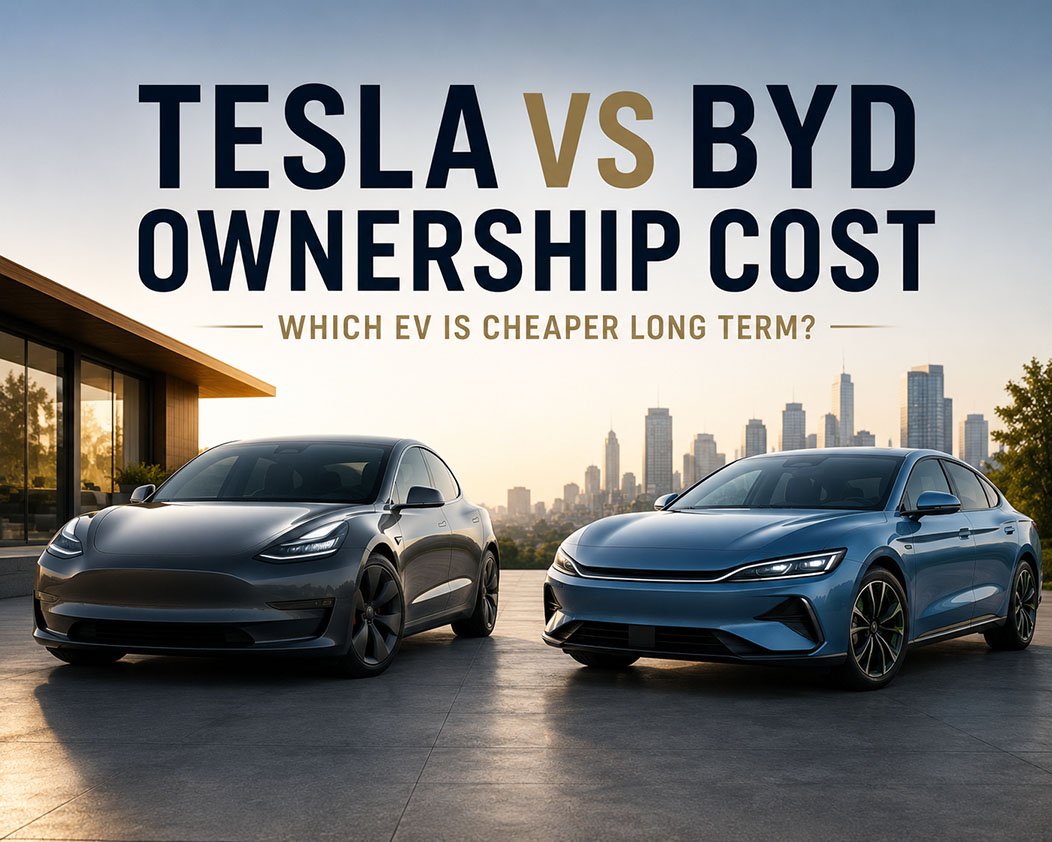
Concept image used to frame the less visible costs that shape long-term EV ownership.
This is where long-term ownership cost can change most dramatically, often without the buyer noticing it at the time of purchase.
Depreciation is often the single biggest long-term cost in a modern EV. Tesla often benefits from stronger used-market recognition, broader buyer familiarity, and better resale confidence in mature EV markets. But Tesla is not insulated from pricing strategy. If a brand resets new-car pricing, used values notice. That is one reason depreciation can become such a large ownership cost even when a car is otherwise easy to live with.
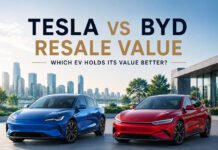
BYD’s story is different. A lower initial purchase price can reduce depreciation pain in absolute terms, but aggressive affordability can also pressure used values if buyers expect the next new BYD to offer more kit for similar money. That is why resale is not just about product quality. It is also about how stable the market feels around the product. For a deeper look at depreciation, see our full guide to Tesla vs BYD resale value.
Real-World EV Ownership Cost Comparison
Ownership-cost calculations are useful, but they cannot capture every real-world variable. Driving habits, charging access, resale timing, and daily usability often influence ownership expenses more than spreadsheet estimates suggest.
This comparison offers a practical ownership perspective beyond purchase price and official specifications.
A practical ownership-focused video explaining EV depreciation, price pressure, charging behavior, and used-market value.
The discussion reinforces one of the central themes of this article: ownership costs depend on much more than the sticker price.
Charging behavior, depreciation, convenience, service access, and long-term confidence often determine which EV ends up costing less over several years of ownership.
Ownership Costs vs Purchase Price: Where Buyers Make Mistakes
One of the biggest ownership-cost mistakes is focusing too heavily on purchase price while ignoring what happens after delivery.
A vehicle that costs less on day one is not automatically cheaper after three to five years. Charging habits, resale value, insurance premiums, software support, service access, and battery confidence can easily outweigh a small difference in purchase price.
This is particularly true in the EV market, where depreciation and charging behavior often have a larger impact on ownership costs than many first-time buyers expect.
The cheapest EV to buy is not always the cheapest EV to own.
Tesla vs BYD Ownership Cost Summary
After comparing purchase price, charging, maintenance, repairs, insurance, battery confidence, software support, service access, and resale value, the cost picture becomes easier to summarize. The table below shows where each brand tends to hold an ownership-cost advantage.
Tesla vs BYD Ownership Cost Factors
| Cost Factor | Tesla | BYD | Ownership Impact |
|---|---|---|---|
| Purchase price | Often higher, depending on trim and market | Often more aggressive on entry price and equipment | BYD may win upfront, but not always overall |
| Charging cost | Depends heavily on home vs public charging | Also depends heavily on local charging access and efficiency | Brand matters less than charging behavior |
| Fast charging convenience | Usually stronger where Tesla charging ecosystem is mature | More dependent on regional third-party charging quality | Tesla can offset some friction costs on long trips |
| Maintenance | Low routine maintenance, like most EVs | Also low routine maintenance, like most EVs | Difference is smaller than many buyers expect |
| Repairs | Depends on local service quality and parts pricing | Depends heavily on dealer maturity and parts access | Weak support can become expensive fast |
| Tires | Can be costlier on larger-wheel or performance models | May be cheaper on lower-power or smaller-wheel trims | Trim choice matters more than badge alone |
| Insurance | Can be expensive in some markets | Varies by familiarity, repair ecosystem, and model | Must be quoted locally, not guessed globally |
| Battery confidence | Benefits from large ownership history and clear warranty structure | Benefits from strong battery reputation and LFP confidence | Both can score well, but buyer trust still varies by market |
| Software support | Usually stronger software maturity and OTA reputation | Can vary more by region and model | Convenience has real ownership value |
| Service network | Mature in some markets, criticized in others | Improving rapidly, but still uneven by country | Local support often decides the real cost story |
| Resale value | ✓ Stronger in mature used EV markets with higher buyer familiarity | ↗ Improving, but still more dependent on local market trust and support | Can be the biggest long-term ownership cost |
| Depreciation risk | Affected by price cuts and market shifts | Affected by aggressive new-car pricing and market maturity | Pricing discipline matters as much as product quality |
Which Brand Is Cheaper for Different Buyers?
The cheaper brand depends less on badge loyalty than on what kind of owner is paying the bills.
Best for Lower Upfront Cost
BYD may be the better answer where pricing is aggressive and dealer support is strong. Buyers focused on monthly outlay, standard equipment, and minimizing day-one spend may find the BYD case easier to justify.
Best for Charging Convenience
Tesla may be the better answer where route planning and charging access are part of the ownership equation, not just an occasional annoyance. In markets with strong Tesla charging access, convenience can translate into lower friction and sometimes lower long-term hassle.
Best for Long-Term Resale Confidence
Tesla still has the edge in many mature EV markets because used buyers understand the ownership story more easily and trust the resale path more readily.
Best for Value-Focused Family Buyers
BYD can be very compelling where its models are well priced, well equipped, and supported properly. A strong equipment-to-price ratio matters when the goal is sensible family transport rather than brand theatre.
Best for Used EV Buyers
For used buyers, the better choice depends less on badge and more on battery health, service history, remaining warranty, software support, and local parts access. A well-supported used BYD can make more sense than a poorly supported used Tesla, and vice versa.
Which EV Fits Long-Term Ownership Better?
BYD may be cheaper for buyers focused on lower purchase price and strong standard equipment, especially in markets where dealer support is already credible. Tesla may be cheaper, or at least more predictable, for buyers who value charging convenience, software maturity, used-market familiarity, and stronger resale confidence.
The answer depends on market, model, incentives, charging access, ownership period, insurance, service network, and resale value. That is why a realistic Tesla vs BYD ownership cost comparison cannot stop at the sticker price.
For most buyers, the better ownership-cost decision depends less on brand loyalty and more on how the vehicle will actually be used.
Buyers with reliable home charging, strong local support, and a clear ownership plan may find either brand inexpensive to own. However, Tesla generally offers stronger charging integration, software maturity, and resale confidence, while BYD often delivers stronger upfront value and equipment for the money.
The cheapest EV long term is usually the one that best matches your charging habits, ownership period, and local market conditions.
FAQ
1. Is Tesla or BYD cheaper to own long term?
It depends on market, charging access, and ownership length. BYD may be cheaper upfront, while Tesla can stay competitive over time through resale confidence, software maturity, and charging convenience.
2. Is BYD cheaper to maintain than Tesla?
Routine maintenance may be similarly low for both, but repair and service costs depend heavily on your local support network.
3. Does Tesla have better resale value than BYD?
In many mature EV markets, usually yes. Tesla often benefits from stronger buyer familiarity and a more developed used market.
4. Are BYD batteries reliable long term?
BYD benefits from strong battery expertise and growing buyer confidence, but warranty terms and long-term ownership support still need to be checked by region and model.
5. Does charging cost differ between Tesla and BYD?
Usually less than buyers think. Charging cost depends more on home versus public charging, local electricity prices, and driving habits than on brand alone.
6. Which is better for used EV buyers, Tesla or BYD?
The better used buy depends on remaining warranty, battery health, service history, and local support, because used EV value can change quickly when one of those pieces is weak.
7. What is the biggest ownership cost for Tesla and BYD?
In many cases, depreciation is the biggest long-term cost, followed by insurance, charging behavior, and market-dependent resale value.