











At some point during an EV purchase, the specifications stop telling you very much. You’ve looked at the range numbers, compared the charging speeds, noted the warranty terms. And then you sit in one car and sit in the other, and something shifts. Not about the numbers but about which one you’d actually want to come back to every morning.
The Volvo EX30 and Hyundai Kona Electric are both compact electric crossovers aimed at urban and suburban buyers who want practical daily EVs without committing to a larger footprint or a larger price. They overlap considerably on paper. But they approach the actual experience of EV ownership from genuinely different directions, and that difference compounds over months and years in ways that a test drive won’t fully reveal.
This isn’t really a comparison of specifications as much as a comparison of ownership personalities.
Volvo EX30 vs Hyundai Kona Electric: Different EV Philosophies
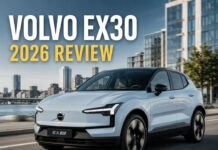
The EX30 arrived as something of a statement. Volvo’s smallest car ever; intentionally so with a cabin that strips back almost everything considered conventional in a modern vehicle interior. One large central screen handles most functions. Physical buttons are reduced to the essentials. The design vocabulary is Scandinavian in the most distilled sense: purposeful restraint, nothing decorative, everything deliberate.
Whether that reads as premium minimalism or as inconvenient reduction depends almost entirely on who’s sitting in it.
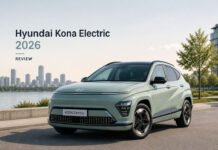
The Kona Electric operates from a different premise entirely. Hyundai’s approach here is that EV ownership already asks quite a lot of new buyers an unfamiliar powertrain, unfamiliar charging infrastructure, unfamiliar routines and the car itself shouldn’t add to that cognitive load. So the Kona’s interior makes sense immediately. Climate controls are physical. The driving position feels established. You don’t need to spend a weekend recalibrating your habits.
Neither philosophy is wrong. But they attract and reward very different types of drivers.
Which EV Is Better for City Driving?
Both cars are compact enough to feel genuinely at home in urban environments. Parking, filtering through traffic, navigating narrow streets neither car punishes you for living in a city. The EX30 genuinely looks at home in dense urban environments; it looks like it belongs in a European capital in a way the Kona doesn’t particularly aspire to.
In traffic, though, the EX30’s screen-heavy interface occasionally surfaces as a friction point. Adjusting the climate or changing audio sources requires more visual attention than reaching for a knob or a button. It’s not dangerous, and you adapt. But adaptation takes time. And during that adjustment period, you’re often thinking about the interface more than the drive itself.
The Kona’s ride comfort tilts softer than the EX30’s, which shows in stop-and-go conditions. The EX30 has a firmer, more purposeful character again, a deliberate design choice that some drivers will find engaging and others will find tiring over longer urban stints. Neither is objectively right. But one of them will probably feel natural much faster.
Visibility is a mild point in the Kona’s favour. The EX30’s styling choices, while handsome, create slightly thicker pillars than older or more conventional designs. Nothing alarming just something you notice on reversing into a tight space for the first few weeks.
Interior Experience: Minimalist vs Practical
This is where the comparison stops being theoretical and where honest self-assessment becomes more valuable than any spec-sheet analysis.
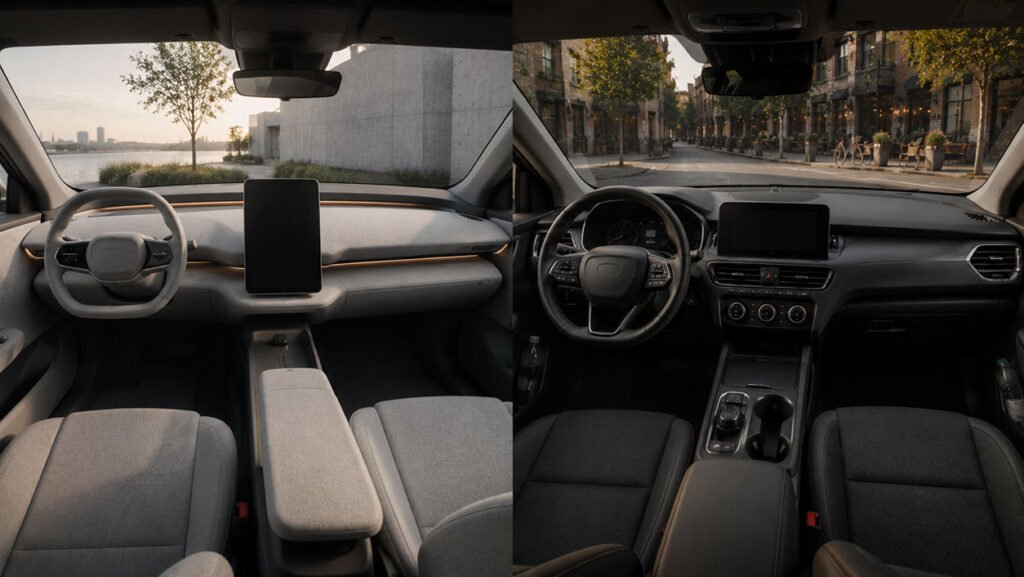
Editorial illustration comparing minimalist premium EV interiors with practical everyday usability-focused cabin design.
The EX30’s interior generates a specific emotional response in most people who sit in it. There’s an immediate sense of intentionality to the materials, layout, the way the single screen anchors the space that reads unmistakably as considered design. For buyers who respond to that, it creates a kind of daily satisfaction that’s hard to quantify. The morning commute feels slightly more intentional.
But there’s a durability question that doesn’t always come up in test drives: how do you feel about that interior six months in?
For some drivers, the learning curve is genuinely short. They absorb the touchscreen logic quickly, build new muscle memory around it, and stop noticing what’s missing. For others and this seems to track more with how people use physical spaces in general than with any particular tech fluency the absence of tactile controls remains a low-level friction point that never quite disappears. The kind of thing that’s barely worth mentioning in isolation, but accumulates into a vague annoyance on cold mornings when you just want to turn up the heat without looking at a screen.
The Kona doesn’t produce that first-impression electricity. It’s a car that makes practical sense immediately and stays that way. The controls are simply where you expect them to be. The ergonomics are calibrated for daily use rather than design photography. Buyers who appreciate that often describe ownership of conventionally-intuitive cars as quietly pleasant a comfort that comes from never having to consciously manage the thing you’re supposed to just be driving.
First-time EV buyers, particularly those simultaneously adjusting to charging routines and regenerative braking and trip-planning habits, often find the Kona’s lower cognitive demand a genuine relief rather than a compromise.
Charging Experience and Public Charging Convenience
For buyers without home charging, both the overall EV charging experience and the practicalities of public charging daily use end up shaping ownership far more than headline battery size suggests.
Both cars use CCS2, which gives them similar access to the growing DC fast-charging networks across Europe and other markets. The EX30’s onboard trip planning integrates charging stops into navigation, which works well in regions with mature infrastructure. The Kona’s charging software is quieter about it more functional than elegant but consistent and rarely surprising.
What’s worth dwelling on here is the difference between peak charging speed and charging predictability. A car that charges at a reliable, consistent rate from a wider range of charge levels often creates less ownership anxiety than one with an impressive peak that narrows quickly at higher states of charge. In day-to-day use, it’s the consistency that shapes your relationship with public charging whether you arrive at a stop with confidence or with mild uncertainty about what you’ll get.
One honest point: neither car resolves the structural challenges of charging in markets where infrastructure is still sparse. The route-planning software can help optimise around it, but if the chargers in your area are unreliable or inconsistently maintained, both cars will absorb that friction. Infrastructure quality varies enormously by country and even by city and that variance deserves more weight in a purchase decision than DC peak speeds.
Suggested video placement: A real-world Volvo EX30 vs Hyundai Kona Electric ownership or charging comparison from 2024 or later works well here. Recommended YouTube search phrases: “Volvo EX30 vs Hyundai Kona Electric real world”, “compact EV comparison 2024”. Aim for an independent, usability-focused video of 8–15 minutes.
Efficiency and Real-World Range
The Kona Electric has earned a reputation for real-world efficiency that’s held up across its generation. Hyundai’s powertrain calibration in this car prioritises consistent consumption the range figure on the display corresponds fairly closely to what you actually use, across a variety of conditions. That alignment between estimated and actual range is an underrated quality in daily EV ownership. It reduces the mental arithmetic.
The EX30 is calibrated differently. Its character leans toward responsiveness, and efficiency follows from that choice rather than leading it. For many drivers particularly those using the car primarily in urban conditions the difference in real-world consumption won’t feel significant. But for efficiency-focused buyers, or those frequently relying on public charging, the Kona’s track record is worth taking seriously rather than discounting as a small statistical advantage.
Efficiency and charging behaviour can also affect how long EV batteries really last over the ownership period. The relationship between discharge patterns, fast-charge frequency and long-term cell degradation is well-documented, and a car that naturally encourages measured energy use tends to support better battery health over time not dramatically, but meaningfully across a five or seven year ownership cycle.
Which EV Feels More Premium?
The EX30 feels more premium in the conventional sense. That’s an honest answer and it’s not particularly close. The cabin atmosphere, the material quality in its better trims, the coherence of the design all of it signals a brand identity that Volvo has maintained at this price level with genuine success.
But it’s worth interrogating what premium actually means in long-term ownership.
Premium can mean arriving at work in something that generates a specific feeling. It can also mean never having to think about your car’s interface when you have other things to think about. The Kona doesn’t produce the former. It does, quietly and reliably, produce the latter.
There’s a kind of calm that comes from driving a car that never asks anything unusual of you. Some buyers find that dull. Others find it particularly after a year or two profoundly comfortable.
Which EV Is Better for Apartment Living?
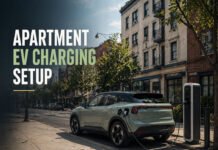
Apartment-based EV ownership is a distinct enough experience from home-charging ownership that it deserves its own discussion. Buyers researching the best EVs for apartment living quickly discover that the relevant questions shift away from home charger installation and toward public charging frequency, efficiency, and how well the car’s software tools reduce planning burden. There’s also the less-discussed question of what it feels like to manage an apartment EV charging setup, and whether you can genuinely live with only an EV on public infrastructure.
On those terms, the Kona Electric’s efficiency advantage becomes more meaningful. If you’re charging primarily at public points, a car that uses less energy per kilometre means fewer stops per week and fewer stops means less time spent managing charging rather than simply driving. Over months, that adds up to a genuine quality-of-life difference.
The EX30’s trip-planning integration is a genuine asset in apartment ownership contexts, particularly in regions where the charging network is well-mapped and reliable. But software tools compensate for infrastructure challenges more effectively than they compensate for frequent charging necessity. In areas where public charging is still patchy, the Kona’s efficiency gives it a more resilient daily range.
First-time EV buyers managing apartment ownership also benefit from the Kona’s lower friction baseline. Managing a new charging routine is easier when the car itself is not simultaneously asking you to learn a new interface.
Ownership Confidence and Long-Term Usability
Confidence in a car is an accumulation. It builds from consistent experiences: the charger that worked as expected, the software that didn’t require relearning after an update, the service appointment that resolved without drama. None of those moments is individually significant. Together they shape how you feel about getting in the car every morning.
The Kona Electric has a longer track record in this category. Hyundai’s EV platform at this level is well-proven, the software has been refined through iterations, and the overall ownership reliability picture is settled. That doesn’t mean the car is without fault, no car is but the density of resolved unknowns is high.
The EX30 is a newer platform, and its evolution has been visible to owners who bought early. Software updates have addressed issues, the charging experience has improved, and the platform is clearly maturing. But for buyers to whom long-term predictability matters more than owning something newer or more distinctive, that maturity gap is worth acknowledging rather than dismissing.
Neither car should be characterised as unreliable. The distinction is subtler than that: one has a longer confidence record, and the other has a more recent one still building.
Which Buyers Should Choose the Volvo EX30?
The EX30 suits a specific kind of buyer rather than a generic one, and it rewards them well when there’s alignment.
- Urban buyers drawn to Scandinavian design values — restraint, coherence, the sense that everything in a space is there for a reason
- Drivers already comfortable with software-centric environments, for whom the touchscreen adjustment is genuinely low friction
- Experienced EV owners who have already developed a charging routine and want a more considered aesthetic choice
- Style-conscious buyers for whom the emotional quality of the daily driving experience matters as much as the practical credentials
- Buyers who value premium atmosphere and are willing to invest time in the learning curve
Which Buyers Should Choose the Hyundai Kona Electric?
The Kona Electric’s appeal is broader in demographic terms, and there’s no diminishment in saying so.
- First-time EV buyers who want a reliable, familiarly-ergonomic introduction to electric ownership
- Practical commuters who want their car to be a settled part of their routine rather than an ongoing engagement
- Efficiency-focused drivers who pay attention to real-world consumption and care about charging frequency
- Apartment residents dependent on public charging, for whom efficiency directly reduces weekly charging stops
- Buyers for whom long-term ownership predictability matters more than initial design impact
- Anyone who’s read this far and realised they’d actually miss physical controls
Potential Weaknesses Buyers Should Consider
Neither car is without genuine compromise, and it’s worth being clear about that.
Volvo EX30:
The software dependency is a real limitation for a non-trivial group of buyers. The near-absence of physical controls creates legitimate daily friction for drivers who find touchscreen interaction fatiguing or distracting. Rear seat headroom is limited in a way that matters if you regularly carry taller adult passengers. Some early buyers encountered software inconsistencies that required patience; that situation has improved, but it’s worth factoring into early adoption decisions.
Hyundai Kona Electric:
The design language is functional and essentially anonymous it won’t generate strong feelings either way. The interior, while ergonomically sound, lacks the atmospheric quality of the EX30; if you care about how a cabin makes you feel beyond its usability, the Kona doesn’t deliver much. For buyers who want their compact EV to feel like a meaningful design choice, the Kona’s conventionality may simply not satisfy that.
Honest ownership consideration means holding both sets of compromises without dismissing either.
Volvo EX30 vs Hyundai Kona Electric: Real-World Ownership Comparison
| Category | Volvo EX30 | Hyundai Kona Electric |
|---|---|---|
| Urban driving | Compact, agile, strong kerb appeal | Comfortable, excellent visibility, forgiving |
| Interior philosophy | Minimalist, software-first, atmospheric | Practical, physical controls, immediately legible |
| Charging usability | Good integration, solid trip planning | Consistent, predictable, lower friction |
| Efficiency | Good; performance-leaning calibration | Strong real-world track record |
| Apartment living | Workable; route planning helps | Efficiency advantage reduces charging stops |
Public charging practicaliWhich EV Fits Your Life Better?The honest answer is that both cars do their jobs well just for different people. The EX30 is a car that rewards a specific ownership personality: someone who has already settled into EV life, who values design coherence and finds the touchscreen paradigm natural rather than effortful, and who wants their compact urban car to feel like a considered aesthetic choice rather than simply a convenient one. For that buyer, the EX30 delivers something genuinely uncommon in its price range. The Kona Electric rewards a different kind of driver. Not a lesser kind a practical, clear-eyed one. Someone who wants their EV to remove friction from daily life rather than add any new variety of it. Someone for whom the morning routine is already complicated enough, and a car that starts, charges predictably, and gets out of its own way is a form of comfort rather than a compromise. If you’re buying your first EV, or if you’re apartment-dependent on public charging, or if you’ve realised after reading this that physical controls are something you’d actually miss the Kona is probably the more intelligent fit for where you are right now. If you respond to the EX30’s design language, if you’re already comfortable with EV ownership, and if a more atmospheric daily experience would meaningfully improve your relationship with the car the EX30 is worth that adjustment curve. The better car is the one that disappears into your life. Both of these can do that. The question is which one does it for you. Quick Ownership QuestionsWhich EV is better for apartment living? The Kona Electric’s stronger real-world efficiency means fewer public charging stops per week, which adds up to a genuinely quieter ownership experience when public infrastructure is your primary option. The EX30 is manageable in apartment contexts, especially where charging networks are well-developed, but the efficiency advantage isn’t trivial when you’re counting on it daily. Which EV has better charging usability? Both use CCS2 and work with the major networks. The EX30’s trip planning is more polished in terms of integration; the Kona’s charging behaviour tends to be more consistent and predictable across varying conditions. In regions with mature infrastructure, the difference is small. In regions where public charging is patchier, the Kona’s efficiency resilience matters more. Is the EX30 too minimalist for some drivers? Yes, genuinely and it’s worth being honest about that. The minimal physical controls aren’t just a preference issue; for some drivers, particularly in heavy traffic or on cold mornings, the added touchscreen interaction creates a low-level friction that doesn’t fully resolve with time. It’s not universal, but it’s not rare either. Which EV is better for first-time EV buyers? The Kona Electric, fairly comfortably. Adjusting to EV ownership involves enough new habits charging routines, range awareness, regenerative braking without adding a new interface paradigm at the same time. The Kona lets you focus on the EV learning curve rather than the car’s own. |