




















Most EV buyers spend their first few weeks obsessing over range figures, charging speeds, and 0-60 times. It is understandable. These numbers are easy to compare and feel objective. But spend a few months actually living with an electric car, and the questions that start mattering are entirely different. Those are often the same questions that determine long-term satisfaction far more than an extra 20 miles of range on paper.
Which one fits more easily into a tight parking space? Which one feels welcoming on a grey Tuesday morning when you are running late? Which one causes fewer small irritations over years of ownership? Which one genuinely fits the way you actually live?
Those are the questions this article attempts to answer. The Tesla Model Y and the Volvo EX30 are two of the most talked-about EVs of 2026, and on paper they appeal to different buyers. In practice, however, many people find themselves cross-shopping them, particularly in European and urban markets where both are genuinely competitive on price. The goal here is not to declare a winner based on a spec sheet. It is to give you a clear-eyed picture of what ownership actually looks like with each car.
Tesla Model Y vs Volvo EX30: Different Ownership Philosophies
These two cars represent genuinely different answers to the same question: what should an everyday electric car be?
The Tesla Model Y is built around a philosophy of practical efficiency. It prioritises space, range, and ecosystem above almost everything else. The cabin is large, the boot is generous, and the entire ownership experience is designed to remove friction. Tesla wants you to stop thinking about charging, software updates, and running costs. Whether or not that promise fully delivers is something we will examine throughout this article, but the intention is clear: the Model Y is a family-oriented, utility-first vehicle that happens to be electric.
The Volvo EX30 takes a completely different approach. It is smaller, more urban in its focus, and more emotionally considered in its design. Volvo is not selling you efficiency first. It is selling you a feeling: premium Scandinavian minimalism in a compact format. The EX30 is the kind of car that makes you feel something when you open the door, and that character is baked into every material choice and interface decision.
Our in-depth Tesla Model Y Juniper Review covers the Model Y’s 2026 updates in detail, and our Volvo EX30 Review explores that car’s ownership dynamics from a longer-term perspective. For this comparison, the focus is squarely on lived experience.
Neither philosophy is wrong. They are just different, and which one suits you depends almost entirely on how your life is structured.
Which EV Works Better in City Life?
Size matters enormously in city driving, and this is one area where the Volvo EX30 has a structural advantage. At around 4.2 metres in length, it is notably shorter and narrower than the Model Y, which sits closer to 4.75 metres. In cities with narrow lanes, tight parking structures, and roads that were laid out centuries before the SUV existed, that difference is not trivial. Can You Really Live With Only an EV in 2026? The EX30 slips into gaps that the Model Y cannot, and the psychological ease of parking a compact car in a busy city should not be underestimated.
Outward visibility is another consideration that rarely shows up in specification comparisons. The Model Y’s large glasshouse and low-set dashboard give a decent view forward, but the thick rear pillars and high boot line can make reversing into tight spots less intuitive than it sounds on paper. The EX30’s smaller footprint helps here too, and most drivers report that it feels lighter and more manageable in traffic.
For daily urban errands, the EX30’s agility works in its favour. It is quick enough off the line to stay with city traffic confidently, and its smaller turning circle reduces the number of multi-point turns you need in cramped car parks. The Model Y is by no means difficult in city traffic, and its cameras and sensors do a thorough job of compensating for its size. But there is a difference between a car that manages the city and one that genuinely suits it.
If your driving is predominantly urban, the EX30 is the easier tool for the job. If your city driving is one part of a broader mix that includes motorways, family trips, and larger supermarket runs, the size penalty of the Model Y matters much less. Buyers who spend most of their time in dense urban environments may also want to explore our guide to the best EVs for apartment living.
Interior Experience: Space vs Atmosphere
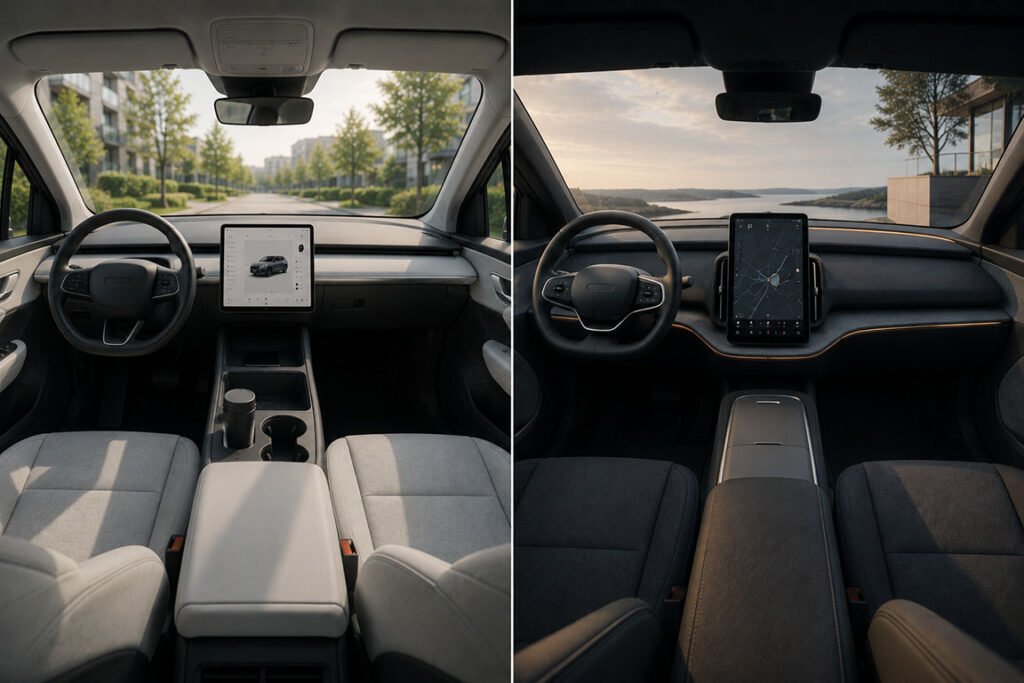
Editorial illustration comparing spacious family-focused practicality with compact premium urban design.
The interior is where these two cars most clearly reveal their different priorities, and it is the section that buyers tend to find most personally divisive.
The Tesla Model Y’s cabin is defined by its openness. The panoramic roof, wide dashboard, and absence of a traditional instrument cluster give the interior a clean, airy quality that passengers genuinely notice. Rear seat legroom is generous for the class, boot space is among the best in its category, and the various storage cubbies feel like they were thought through by someone who actually uses a car for everyday life. The under-boot frunk adds useful extra storage. For a family, or for anyone who regularly carries bags, sports equipment, or passengers, the Model Y’s interior is simply more accommodating. That approach appeals to buyers who prioritize utility and practicality, while others may find it less emotionally engaging than more design-focused interiors.
The Volvo EX30 offers something qualitatively different. The cabin is smaller, but it does not feel inadequate. What Volvo has done is prioritise atmosphere over volume. The materials are noticeably premium for the price point: soft-touch surfaces, considered colour options, and a sense of design coherence that feels genuinely Scandinavian rather than aspirationally European. The large central speaker bar and the single-screen interface give the interior a distinctive character. Sitting in the EX30 feels like a deliberate design decision, not a default.
The trade-off is space. Rear legroom in the EX30 is acceptable for shorter journeys but less comfortable on longer ones, especially for taller adults. Boot capacity is adequate for city life but noticeably smaller than the Model Y. Families with children, or anyone who regularly carries a pushchair, large shopping, or sporting equipment, will notice the limitation.
For a single owner or a couple who prioritises how a space feels over how much it holds, the EX30 is more compelling. For growing families, frequent travellers, or anyone who uses their car as a mobile storage unit, the Model Y wins without serious contest.
Charging Experience and Long-Distance Travel
Tesla’s Supercharger network remains one of the strongest ownership advantages available to EV buyers in many markets. For Model Y owners, the practical effect is simple: plug in at any Supercharger, and the car handles everything else. Payment is automatic, charging speed is reliable, and the navigation system plans routes around charging stops without requiring any manual research. On a long motorway journey, this removes a layer of logistical anxiety that non-Tesla EV owners still regularly encounter.
The EX30 relies on third-party charging networks, which in many markets means navigating a patchwork of providers with varying reliability, different payment systems, and occasional frustrating downtime. The car itself charges at up to 153kW DC, which is a competitive figure that enables reasonably fast top-ups. But charging speed is only one part of the experience. The broader network infrastructure, the reliability of individual chargers, and the ease of payment all affect how confident you feel planning a longer trip.
This is not an issue specific to Volvo. It is a challenge for all non-Tesla EVs, and the situation has improved considerably as networks have expanded. But if long-distance travel is a regular part of your life, the Model Y’s integration with the Supercharger network provides a level of convenience that the EX30 cannot yet match.
For owners who primarily charge at home overnight, this distinction matters less day-to-day. It becomes most relevant on road trips, weekend getaways, and any journey that pushes beyond a comfortable single-charge range.
If you are weighing up the long-term cost implications of ownership alongside charging practicalities, our analysis of How Much Does EV Maintenance Really Cost? provides useful context on running costs across both models.
What Is It Really Like to Live With These EVs?
Reading reviews and specifications only tells you so much. The most honest ownership accounts come from people who have spent months or years with these cars in real conditions.
Long-term ownership impressions often reveal strengths and frustrations that short test drives never uncover.
Ride Comfort and Daily Character
Over daily use, the two cars develop noticeably different personalities.
The Model Y rides with a composed, mature quality. It absorbs urban imperfections competently, settles on motorways with a reassuring solidity, and generally feels like a car that has been tuned for relaxed, confident progress. It is not exciting to drive in the way a sports car is, but that is not the point. It is stable, predictable, and genuinely relaxing over distance. For high-mileage commuters or anyone who covers a lot of ground weekly, that composure is a virtue.
The EX30 is more engaging. It is lighter, more alert in its responses, and has a sharper quality to its steering that makes urban driving feel more involving. Around town, this translates into a more spirited character that many drivers find genuinely enjoyable. On longer motorway stretches, the EX30 is comfortable but slightly less settled than the Model Y, particularly in its standard suspension configuration.
Neither ride is poor. The difference is one of character rather than competence. If you want a car that feels substantial and relaxed, the Model Y suits you better. If you want something that feels alive and responsive in everyday driving, the EX30 has an edge.
Real-World Efficiency and Range
Official range figures should be viewed as useful benchmarks rather than guaranteed real-world outcomes.
According to EV Database, the Model Y Long Range in real-world conditions typically delivers somewhere in the range of 470 to 510 kilometres in mild weather, dropping more noticeably in cold conditions due to battery thermal management demands. The EX30 Single Motor Extended Range returns roughly 320 to 360 kilometres under comparable conditions. These are meaningful differences, but the more relevant question is whether either car runs short of range in normal daily use, and for most owners the answer is no.
The majority of daily driving, including commutes, school runs, and weekend errands, falls well within the EX30’s comfortable real-world range. The gap becomes relevant primarily on road trips or in situations where home charging is unavailable for extended periods. Our article on Can You Really Live With Only an EV? explores this question in depth for both urban and rural owners.
Both cars benefit from one-pedal driving and regenerative braking, which meaningfully extends real-world efficiency in stop-start city traffic. The EX30 is slightly more efficient per kilometre due to its lower weight, which partially offsets its smaller battery.
Apartment Living and Urban Ownership
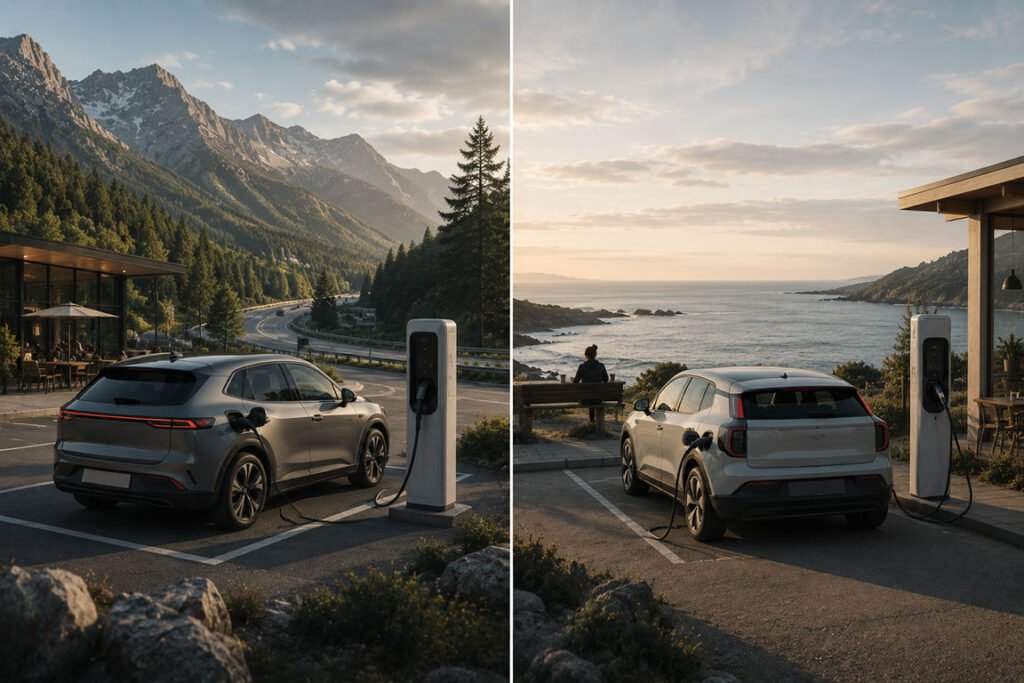
Editorial illustration comparing apartment-friendly EV ownership and everyday charging practicality.
One of the most underexplored aspects of EV ownership is how much the experience depends on your charging situation at home. Owners with a dedicated home charger or a garage enjoy a fundamentally different experience from those relying on public infrastructure.
For apartment dwellers without dedicated parking, both cars require a degree of charging planning that house owners typically do not face. The key difference is that the Model Y’s larger battery means fewer charging sessions per week for the same mileage, which reduces the logistical burden somewhat. The EX30’s smaller battery means you may need to top up more frequently if relying entirely on public chargers.
Access to Tesla’s Supercharger network again provides Model Y owners with a more predictable public charging experience. For EX30 owners, understanding the local public charging landscape before committing to the car is genuinely worth doing. In cities with dense, reliable public networks, the EX30 is a practical choice for apartment living. In areas where public charging is patchy, the larger-battery Model Y provides more buffer.
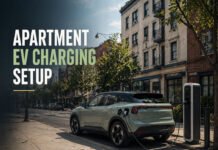
Buyers considering either vehicle should also read our guide to the Best EVs for Apartment Living, while those planning home charging can find practical advice in our Apartment EV Charging Setup Guide.
Software, Technology and Ease of Ownership
Tesla’s software ecosystem remains one of the Model Y’s most significant ownership advantages. The Tesla app is mature, genuinely useful, and tightly integrated with the car. Remote climate control, charging monitoring, trip planning, and over-the-air updates all function with a consistency that Tesla has spent years refining. When a software update improves a feature or adds new capability, it appears on your car automatically overnight. The interface inside the car, while polarising in its minimalism, is fast and responsive, and most owners adapt to it quickly.
The one area where some buyers have mixed feelings is the reliance on the central touchscreen for virtually all controls, including basic functions like adjusting mirrors or opening the glovebox. This is a deliberate design choice, and for most owners it becomes natural. For those who prefer physical controls for certain functions, the adjustment period is real.
The Volvo EX30 runs Google Built-In, which brings Google Maps, Google Assistant, and the broader Android ecosystem into the dashboard. For Android users in particular, this feels intuitive and well-integrated. The interface is clean and the voice assistant is capable. The EX30’s software also receives over-the-air updates, though Volvo’s update cadence is less aggressive than Tesla’s.
Where the EX30 creates occasional frustration is in the depth of menus required to access certain settings, and the single-screen layout means that changing audio source while navigating requires a few more steps than ideal. These are minor annoyances in daily use, but they are worth mentioning because software experience significantly affects daily satisfaction with modern EVs.
Potential Weaknesses Buyers Should Know
Tesla Model Y Weaknesses
The Model Y is not without its frustrations. Build quality consistency has historically been a point of concern for Tesla, and while the Juniper refresh improved fit and finish noticeably, some owners still report minor panel alignment issues or interior trim details that feel below what the price warrants. Tesla’s customer service infrastructure has also drawn criticism, particularly in markets where service centres are geographically spread out. The near-complete reliance on the touchscreen for routine functions also remains a point of contention among some owners, particularly those who prefer physical controls.
The driving experience, while competent, is notably uninvolving for those who enjoy a sense of connection with the road. The Model Y is fundamentally utilitarian in its driving character, and buyers coming from enthusiast-oriented cars sometimes find it lacks emotional engagement.
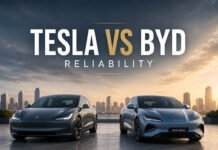
Tesla’s brand perception has shifted in certain markets, which for some buyers is a practical consideration when it comes to resale value and social context. Our comparison of Tesla vs BYD Reliability examines long-term dependability records in more detail, and the Tesla vs BYD Ownership Cost analysis covers financial aspects of the ownership equation.
Volvo EX30 Weaknesses
The EX30’s principal weakness in daily ownership is rear passenger space and boot capacity. For anything beyond solo or two-person use, the compromise is real and cumulative over time.
Early production models in some markets were affected by software issues that required dealer visits to resolve. Volvo has addressed many of these through updates, but it is worth checking recent owner forums for current-model reliability data before purchasing. The cabin’s minimalist approach also divides opinion, as many commonly used functions require interaction with the central touchscreen.
The reliance on third-party charging networks is a practical limitation for high-mileage drivers or frequent long-distance travellers. In markets where charging infrastructure is still developing, this requires more planning than equivalent Model Y ownership. The EX30 also offers less cargo flexibility, with no frunk storage and a more limited towing capacity than the Model Y.
Who Should Buy the Tesla Model Y?
- Families with children or regular passengers who need genuine rear seat space
- Owners who frequently travel long distances and want stress-free charging
- Buyers who prioritise total cargo capacity and everyday practicality
- Anyone who wants a mature, proven software ecosystem with strong OTA updates
- Drivers who cover high weekly mileage and value composure over character
- Buyers in markets where the Supercharger network is well-developed
- Those moving from a larger SUV or estate car who need similar usability
Who Should Buy the Volvo EX30?
- City drivers who prioritise manoeuvrability and compact dimensions
- Solo owners or couples without regular large-item carrying needs
- Buyers who value interior quality and design atmosphere over raw space
- Those attracted to the premium Scandinavian design aesthetic
- Android users who want a naturally integrated Google experience
- Drivers who find the Model Y’s character too anonymous or utilitarian
- Buyers who primarily charge at home and travel shorter daily distances
Tesla Model Y vs Volvo EX30 Ownership Summary
| Category | Tesla Model Y | Volvo EX30 |
|---|---|---|
| City Driving | Good, but size requires more effort | Excellent, compact and agile |
| Family Practicality | Excellent, generous space throughout | Limited for families, better for couples |
| Interior Quality | Clean and spacious, functional feel | Premium atmosphere, distinctive character |
| Charging Convenience | Excellent via Supercharger network | Good at home, variable on public networks |
| Road Trips | Excellent, best-in-class network access | Capable but requires more planning |
| Apartment Living | Good, larger battery reduces top-up frequency | Manageable with a reliable local network |
| Software | Mature, fast, comprehensive ecosystem | Google built-in, capable but shallower |
| Efficiency | Good real-world range, strong on motorways | Slightly more efficient per km, smaller battery |
| Resale Value | Generally strong but market-dependent | Competitive but less historical data available |
| Long-Term Ownership Confidence | High, established infrastructure and support | Good, improving as Volvo expands EV support |
Which EV Fits Your Life Better?
After spending time with both cars in real-world conditions, the honest conclusion is that neither is objectively better. They are better for different people.
The Tesla Model Y remains the more rational choice for buyers who need genuine versatility. The space, the Supercharger network, the software maturity, and the long-distance confidence all add up to an ownership experience that accommodates most life situations without compromise. According to J.D. Power’s 2025 EV ownership satisfaction data, Model Y owners continue to rate overall satisfaction highly, with charging infrastructure cited as a primary driver of confidence.
The Volvo EX30 is the more emotionally compelling choice for buyers whose life genuinely fits its format. If your driving is primarily urban, your passenger load is usually one or two people, and you value the way a car feels and looks as much as what it objectively does, the EX30 rewards you in ways that the Model Y does not attempt.
The better EV depends entirely on how your daily life is actually structured. Buy the Model Y if your life demands a versatile, practical workhorse with a mature ecosystem. Buy the EX30 if your life suits a compact, characterful premium EV that makes city driving genuinely enjoyable.
Both cars represent serious, well-developed answers to the question of what an everyday electric car should be. The better choice is not the EV with the stronger spec sheet. It is the one that fits your parking, charging routine, passenger needs, and daily rhythm with the least friction.
Quick Ownership Questions
Is the Tesla Model Y worth the extra money?
For buyers who regularly carry passengers, travel long distances, or want the most stress-free charging experience available, the Model Y’s additional cost is generally justified by the breadth of capability it offers. For primarily urban, shorter-range ownership, the EX30 provides a strong alternative at a lower price point.
Is the Volvo EX30 better for city driving?
In most respects, yes. Its shorter wheelbase, smaller footprint, and lighter overall feel make it noticeably easier to manage in urban environments. Parking is less stressful, manoeuvring in tight spaces requires less effort, and the agile character of the car suits stop-start city traffic naturally.
Which EV is better for road trips?
The Tesla Model Y, and it is not particularly close. The integration with the Supercharger network provides a level of route-planning confidence and charging reliability that the EX30, reliant on third-party infrastructure, cannot currently match. For occasional long-distance travel the EX30 is capable, but for regular road trips the Model Y is the more suitable tool.
Which EV is easier to live with every day?
This depends on your specific daily life. The Model Y is easier to live with if your daily life involves family use, long distances, or varied cargo needs. The EX30 is easier to live with if your daily life is primarily urban, your passenger count is low, and your priority is a premium, characterful ownership experience in a compact package. The right answer is personal, not universal.