













There is a particular kind of car that automotive journalists find difficult to write about. Not because it is bad. But because it is quietly, competently, occasionally surprisingly good — without doing anything dramatic enough to anchor a review around. The MG4 is that kind of car.
It launched at a price that made rival manufacturers uncomfortable. It offered range, equipment, and build quality that had no business being available at the price. And then, for the 2026 update, MG did something manufacturers rarely do well: it listened, fixed the weak points, and kept the price competitive rather than using the refresh as an opportunity to charge more.
The result is an affordable EV that, in 2026, has earned a more serious conversation than many buyers give it credit for.
Why the MG4 Still Matters in 2026
The affordable EV segment has become crowded in the time since the MG4 first arrived. The Renault 5, the BYD Dolphin, the Volkswagen ID.3 in various guises, and a growing number of smaller hatchbacks now occupy the space the MG4 once held largely on its own terms. More competition should, in theory, have pushed the MG4 toward irrelevance.
It has not.
What keeps the MG4 relevant is the combination it offers at its price point: a 64 kWh or 77 kWh battery, rear-wheel drive dynamics, a WLTP range of up to 280 or 338 miles depending on configuration (verify current trim details with your regional MG dealer or the official MG website, as the lineup has been simplified for 2026), and a seven-year, 80,000-mile warranty that still represents one of the more reassuring ownership commitments in the segment. Add the 2026 interior and software updates which have meaningfully addressed the original’s most consistent complaints and the value proposition remains genuinely strong.
The MG4 often feels like a car designed by people who understood the assignment. In a segment where affordability can be used as an excuse for compromise, MG has consistently chosen where to save money in ways that are less likely to affect daily life. The result is a car that is harder to dismiss than its badge or its price might suggest.
Exterior Design: More Character Than Most Budget EVs
The MG4’s exterior styling has always been a little unexpected for a car in its class. The angular body, sharp creases, insect-eyed headlight cluster, and general sense of visual intent give it a character that more expensive hatchbacks sometimes lack. It is not subtle. But it is coherent, and it has aged well.
For 2026, the exterior revisions are deliberately minimal. MG made the sensible call not to alter what owners consistently said was one of the car’s most appealing qualities. The twin rear spoilers have been rationalised into a single unit, and there are minor updates to the bumper treatment nothing that would register unless you were looking for it. The car still reads as purposeful on the road.
What is worth noting is that the MG4 occupies a slightly unusual proportional position. It is physically smaller than some rivals in the compact electric segment yet manages to feel reasonably spacious inside. That is a function of the flat-floor architecture and considered interior packaging, which is discussed below. On the road, it does not carry the bulk of some larger EVs, which is useful in urban conditions.
Design-wise, the MG4 makes a reasonable case that affordable does not have to mean anonymous. That matters in a class where some competitors are competent but visually forgettable.
Interior Experience and Daily Usability
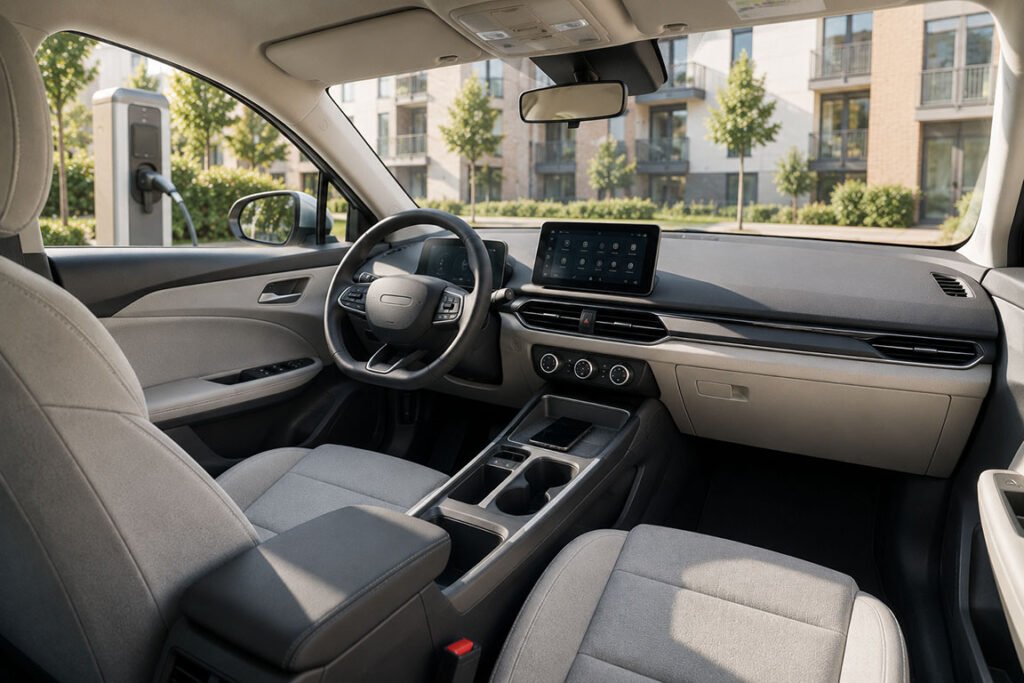
Editorial illustration highlighting practical EV cabin design, intuitive controls, useful storage solutions, and the everyday comfort that contributes to a positive ownership experience.
Early MG4 reviews often praised the car’s value while being noticeably less enthusiastic about the cabin itself. It worked. It was logically arranged. The screens were adequately sized. But the materials had a budget quality that was difficult to ignore, and the touchscreen software while functional could be slow and occasionally erratic in a way that reminded you of what the car had cost.
For 2026, MG has addressed this directly. The updated interior borrows its layout and display arrangement from the more expensive MGS5, bringing a 12.8-inch central touchscreen and a 10-inch driver’s display alongside and this is the detail that matters most physical controls for air conditioning and audio volume. The return of tactile buttons for frequently adjusted functions is a meaningful improvement. It removes the friction of navigating a menu to change the cabin temperature on a cold morning.
The seat quality and material choices have been upgraded as well. The 2026 cabin feels noticeably more considered than the outgoing version, without pretending to be something it is not. It is still a car in this price range, and certain hard-touch plastics remind you of that fact. But the overall impression is of a manufacturer that has studied what frustrated owners rather than simply cycling to the next model year unchanged.
Front seat comfort is good for the class. The driving position is straightforward to adjust and the view forward is clear. Rear seat space is adequate rather than generous adults fit, but longer journeys in the back require a reasonable tolerance for the limitations of a compact car. The boot is modestly sized and will feel familiar to anyone moving from a conventional hatchback, though not expansive. There is no front storage compartment, which is a distinction worth noting against some rivals.
The most impressive thing about the MG4’s interior isn’t what it delivers. It’s how little you have to work against it once the novelty of a new car settles into a routine. Which is precisely the right outcome.
Charging Experience and Public Charging Practicality
The MG4’s charging story is one of the more important elements of its ownership case, and it requires an honest treatment.
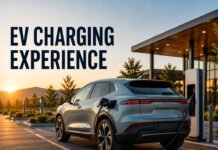
DC fast charging capability on the 2026 MG4 reaches up to 144 kW on the standard Long Range model and up to 154 kW on the Extended Range version, according to Carwow’s verified specifications. That translates to a 10–80% charge time of roughly 25 to 40 minutes depending on configuration and conditions — figures that are broadly competitive with similarly-priced rivals, though not class-leading. The Renault 5, for comparison, charges at a higher peak rate in some configurations. The MG4’s charging speed is capable, not exceptional.
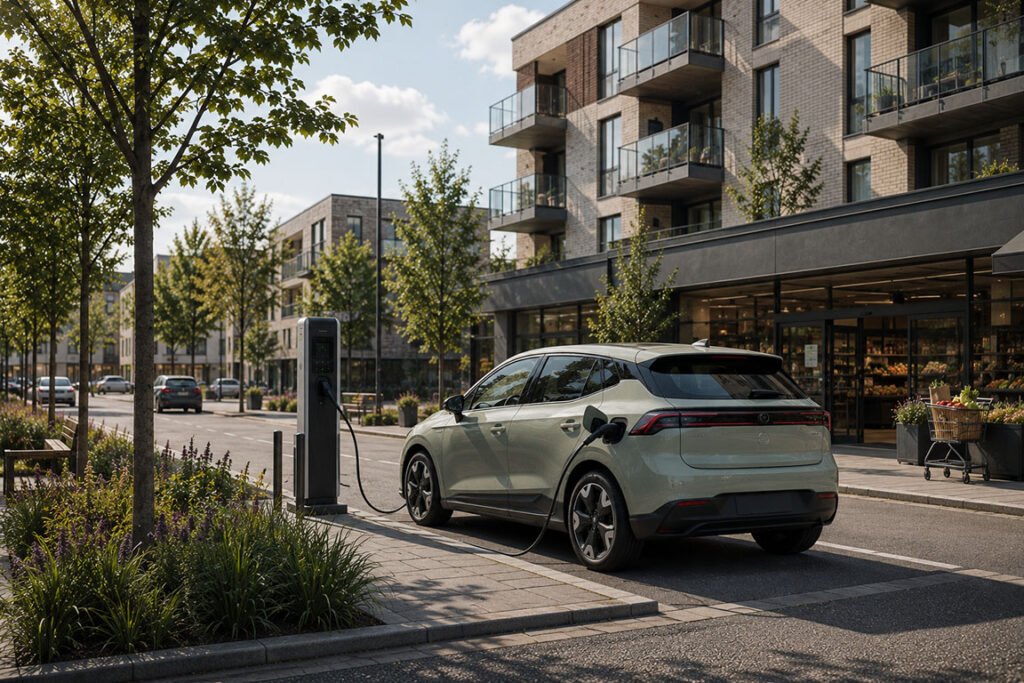
Concept image showing affordable EV charging experience
What this means in practice is that DC public charging stops are usable but not especially brief. A 30-minute stop at a working rapid charger recovers meaningful range enough to continue the journey. But anyone expecting the near-instant session times of a Hyundai Ioniq 5 or similar 800-volt architecture will need to adjust expectations. The MG4 uses a 400-volt system, which is standard for the class.
On AC charging, the MG4 does not support three-phase charging in most markets a limitation that affects overnight charging speed at certain public or destination chargers. For home charging, this rarely matters. For regular reliance on public AC infrastructure, it is worth understanding before purchase.
The CCS charging port is located at the rear left of the vehicle. This is a practical position for most public charging configurations.
Road trips in the MG4 are manageable rather than effortless. For many buyers, that’s a perfectly reasonable trade-off. The MG4 does not try to eliminate charging stops entirely. Instead, it offers enough range and charging capability to make occasional long-distance travel practical while keeping purchase costs significantly lower than many rivals.
Buyers who rely primarily on public charging should also read our guide to the best EVs for apartment living before deciding whether the MG4 fits their daily routine.
What Is the MG4 Like to Live With Every Day?
After a full year of ownership, this MG4 owner shares practical insights on everyday usability, charging, comfort, and the real-world pros and cons often missing from short test drives.
Ride Comfort, Driving Feel and Daily Character
The MG4 drives better than its price point would lead most buyers to expect. That was true when it launched, and it remains true in 2026.
The rear-wheel drive layout which gives the car a more natural weight distribution than front-wheel drive competitors contributes to handling responses that feel composed without being sporty. In urban conditions it is easy and manoeuvrable. On an empty road it has a directness that is quite satisfying for a family-oriented hatchback. The MG4 XPOWER, with its dual-motor AWD setup, is genuinely quick but the standard variants are not trying to be performance cars, and they do not feel inadequate for declining that brief.
Ride comfort at lower speeds is good. The MG4 manages typical urban road surfaces without drama. At motorway speeds, the picture is slightly more mixed: wind noise and road noise are present more than in premium EVs, and some rougher motorway surfaces generate vibration through the cabin. This is a known quality of the car rather than a flaw, and it sits in a broadly expected place for the price point. But buyers arriving from a more refined car should calibrate expectations.
One-pedal driving and regeneration feel well-adjusted in everyday use. The selectable regeneration levels work as expected, and the default settings feel natural without being intrusive for drivers new to EVs.
The overall driving character of the MG4 is calm and capable the kind of car that earns quiet appreciation rather than enthusiasm. That is entirely appropriate for the ownership experience it is trying to deliver.
Real-World Efficiency and Range
WLTP figures for the 2026 MG4 sit at up to 280 miles for the standard Long Range (64 kWh usable) and up to 338 miles for the Extended Range (77 kWh usable), depending on specification. As with any WLTP figure, treat these as an indication of relative capability rather than a guarantee of real-world performance.
Real-world efficiency testing by Auto Express found an average of around 3.8 mi/kWh in mixed conditions which, from a 64 kWh pack, translates to approximately 240+ miles in moderate temperatures. That is a respectable real-world result and broadly consistent with what most owners report in typical mixed driving.
Highway range is more limited. At motorway speeds above 70 mph, efficiency drops considerably as it does with any EV. The MG4 is a more efficient city and mixed-road car than it is a high-speed highway cruiser. Buyers planning regular long motorway trips should factor this into their range expectations and ensure charging stops are available at appropriate intervals.
Cold weather performance follows the pattern of most lithium-ion battery EVs. Auto Express and other independent testers have recorded real-world efficiency dropping to around 3.1 mi/kWh in winter conditions a meaningful reduction that affects usable range by roughly 15–20% in cold climates. This is not unusual for the class, but it is an honest consideration for buyers in regions with cold winters.
The MG4’s efficiency advantage is most apparent in urban and mixed-road use, where its relatively light kerb weight and sensible energy management work well. It is a competitive city commuter. It is a less dominant motorway car.
Long-term battery concerns are often exaggerated, but understanding how EV batteries actually age helps put real-world MG4 ownership into perspective. Our guide to how long EV batteries really last explores the evidence in more detail.
Always verify current range estimates through the official MG website or sources such as WLTP test data; figures can vary by trim and region.
Apartment Living and Urban Ownership
The MG4 is a reasonably good choice for apartment dwellers with some honest caveats attached.
The car’s compact exterior dimensions make it easier to live with in urban environments than larger EVs. It fits standard parking spaces without excessive difficulty, and the turning circle is tight enough to manage city manoeuvres. In that sense, it suits urban ownership well.
The charging picture is more dependent on your specific situation. Without home charging, the MG4’s 40 kW AC charging capability — the figure that matters for destination or overnight public AC charging limits how quickly you can replenish the battery using slower public infrastructure. In cities with good access to DC rapid chargers, a regular top-up stop of 30–40 minutes recovers the range most urban drivers will need for several days. That routine is manageable if you plan for it.
What makes the MG4 surprisingly apartment-friendly is that most urban drivers use far less range each day than they imagine. For many owners, one or two public charging sessions per week are enough to keep the car comfortably within its routine. If your typical week involves commuting and short trips, even a partial charge from a public station a couple of times a week is sufficient. The car does not require full charges to feel practical in a city context.
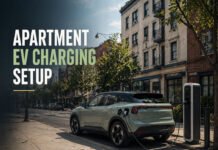
Buyers considering public-charging-only ownership should also read our Apartment EV Charging Setup guide before deciding whether the MG4 fits their lifestyle.
The honest advisory is this: if your nearest reliable DC rapid charger is more than a short journey away, and public AC charging in your area is inconsistent or sparse, the MG4’s ownership experience becomes noticeably more effortful. The car rewards urban charging infrastructure rather than creating its own. That is true of most EVs at this price point, but it is worth naming clearly.
For buyers still unsure about relying entirely on charging infrastructure, our guide on whether you can really live with only an EV explores the reality in more detail.
Software, Tech and Long-Term Ownership Confidence
Software has historically been the MG4’s most discussed weakness. The original system was functional but could feel slow, with occasional glitching that reviewers and owners noted regularly. It was not a serious problem the core functions worked but it was a consistent reminder of where development investment had not gone.
The 2026 update changes this materially. The new infotainment system, borrowed from the MGS5 and MGS6, brings a 12.8-inch touchscreen with improved processing speed and a noticeably smoother interface. Wired Apple CarPlay and Android Auto are supported. The system is not the most polished in the segment some rivals offer more fluid software experiences but it is now substantially better than the outgoing version, and the addition of physical controls for key functions reduces reliance on the touchscreen for the interactions that matter most.
OTA (over-the-air) software updates have been part of MG’s stated roadmap, though implementation and frequency can vary by market. Verify current OTA capability for your region with your MG dealer.
The seven-year, 80,000-mile warranty remains one of the most competitive ownership commitments in the affordable EV segment. According to sources including Electrifying.com, it surpasses the standard warranty terms of Volkswagen, Skoda, and Cupra, among others. That length of manufacturer backing provides genuine reassurance, particularly for buyers considering the MG4 against European alternatives at similar price points.
Some buyers remain cautious about Chinese EV brands, particularly when long-term reliability and resale value are part of the decision. That hesitation is understandable, although the MG4’s growing owner base and lengthy warranty help reduce some of that uncertainty. MG’s reliability survey performance has not always been flattering What Car’s reliability data has placed MG poorly in some years. The 2026 model’s improved software should address some of the most frequently reported issues, and the extended warranty provides a structural backstop. Whether MG’s long-term reliability record develops as the brand matures will take more time to assess fully. That is an honest position.
The MG4 succeeds by making sensible compromises in the right places. Software and interior were where the original generation needed the most work, and the 2026 update has delivered on both.
Potential Weaknesses Buyers Should Know
Interior materials. The 2026 interior is noticeably improved, but some hard-touch plastics in lower-contact areas remind buyers of the car’s price bracket. The cabin quality is no longer a genuine objection to ownership but it is not the same as a more premium product.
Highway refinement. At motorway speeds, wind and road noise are present at levels that suit budget-conscious buyers but may feel busy to those arriving from quieter, more refined cars. This is unlikely to be a dealbreaker for typical ownership, but it is real.
AC charging speed limitation. The absence of three-phase AC charging in most markets is a genuine constraint in some European countries and public charging situations. DC rapid charging compensates, but the gap is worth understanding before purchase.
Software still maturing. The 2026 infotainment upgrade is meaningful, but MG’s software ecosystem is younger than that of some established rivals. Feature depth, navigation quality, and update consistency may not match the standard of more mature platforms.
Reliability history. MG has not historically performed well in consumer reliability surveys. The 2026 model should benefit from improved software — the source of many previous complaints but the long-term mechanical and electrical reliability picture will take time to establish with confidence.
Resale value uncertainty. Chinese-branded EVs generally face more uncertainty around used values than established European or Korean manufacturers. If resale value matters to your ownership calculation, this is a real consideration. Finance deals often make this less relevant than outright purchase.
Dealer network variability. MG’s dealer network has grown, but coverage and service quality can vary depending on location. Checking available service support in your area before purchase is sensible.
Who Should Buy the MG4?
It suits you well if:
- Value for money is your primary purchase criterion and you want the most range and equipment for the budget
- You have access to DC rapid charging near home or at a regular stopping point
- You primarily drive in urban or mixed conditions rather than long daily motorway runs
- You are comfortable with a brand that is newer to the segment and understand the reliability considerations
- Interior space requirements are modest you and two or three adults rather than a consistently full five-seat load
- Rear-wheel drive dynamics and a more spirited feel matter to your driving experience
- You want one of the best value-for-money EVs currently available
- The seven-year warranty provides the ownership confidence you need from a newer brand
It may not suit you if:
- Reliability survey results and long-established brand track records are important to your purchase decision
- You will be driving long motorway stretches regularly and need consistent, low-stress highway range
- You need three-phase AC charging or your public charging infrastructure is predominantly slow AC
- Interior quality parity with European alternatives matters to you
- Resale value is a critical factor and you plan to sell privately after a few years
- You need genuinely generous rear-seat space for regular adult passengers
MG4 Real-World Ownership Summary
| Ownership Area | Assessment | Notes |
|---|---|---|
| City driving | Very good | Compact dimensions, good visibility, easy to place; comfortable urban character |
| Ride comfort | Good | Composed at lower speeds; some road and wind noise becomes noticeable at motorway speeds |
| Charging usability | Good | Up to 144–154 kW DC peak; 10–80% in approximately 25–40 minutes; no three-phase AC in most markets |
| Apartment living | Conditional | Works well with reliable DC rapid charge access; more effort without consistent public charging nearby |
| Road trips | Moderate | Extended Range option makes longer journeys manageable; requires planned stops; not effortless |
| Interior practicality | Good | 2026 update meaningfully improved; physical controls now present; boot and rear seat space modest |
| Software usability | Good | New 12.8-inch system from MGS5 is a clear step up; maturing but not yet class-leading |
| Efficiency | Good | Strong in urban/mixed use; real-world motorway range noticeably below WLTP; cold weather affects range |
| Family usability | Moderate | Fine for couples and small families; rear space and boot not best-in-class for five adults |
| Long-term ownership confidence | Good | Seven-year warranty provides reassurance, though long-term reliability data is still developing. |
Why the MG4 Became One of the Most Important Affordable EVs
When the MG4 first appeared, it was easy to treat as a curiosity. A Chinese-backed brand with a heritage badge, offering an electric hatchback at a price that should not have been achievable with those specifications. The natural assumption was that something, somewhere, was missing.
What reviewers and buyers gradually found was that the trade-offs were not where they expected. The powertrain was sound. The range was genuine. The handling was better than it had any right to be. The gaps were in the interior quality and the software areas where expectation-setting was easier and where investment could be applied over time.
The 2026 update demonstrates that MG has been paying attention. The infotainment system is genuinely better. The interior is genuinely nicer. The price has not risen to compensate. That combination — improvement without the opportunity to charge more for it is rarer than it should be in the automotive industry.
The MG4 does not aim to be the most refined, the most technologically advanced, or the most prestigious electric car available. It aims to be the most sensible purchase decision at its price point for buyers who need a practical, daily-usable EV with real range and a reassuring warranty. In 2026, it still achieves that with reasonable consistency.
The more useful question is not whether the MG4 is the best EV on sale. It is whether there is another EV that offers more real-world value for the same money. In 2026, that remains surprisingly difficult to answer.
Is the MG4 Right for You?
Is the MG4 still worth buying in 2026?
For buyers whose primary consideration is value the most range, equipment, and usability for the money the MG4 remains one of the most compelling options in the affordable EV segment. The 2026 update has addressed the interior and software weaknesses that were the most consistent objections to the previous version. The seven-year warranty provides ownership confidence that rivals at the price do not always match. If your priorities align with what the MG4 offers, it is worth taking seriously.
Is the MG4 good for road trips?
It is manageable, particularly in Extended Range specification with its WLTP-estimated 338-mile figure. DC rapid charging at up to 154 kW means stops are in the 25–40 minute range rather than the near-20 minutes of some faster-charging rivals. Longer journeys work but require straightforward planning around charging availability. Verify current range figures for specific trim levels with MG directly or through sources such as WLTP data, as specifications can vary.
Is the MG4 good for apartment living?
It can be, but the answer depends heavily on your access to DC rapid charging infrastructure. With a reliable rapid charger nearby, the car’s ownership routine is very workable a 30-minute stop every few days is sufficient for typical urban use. Without that access, the lack of three-phase AC charging in most markets makes the calculus more difficult. Research what is available near your home and regular routes before committing.
Is the MG4 the best budget EV you can buy in 2026?
For many buyers, yes. It combines competitive range, useful equipment, rear-wheel-drive dynamics, a seven-year warranty, and a price point that remains difficult to match. It is not perfect, but few EVs offer as much value for the money.