















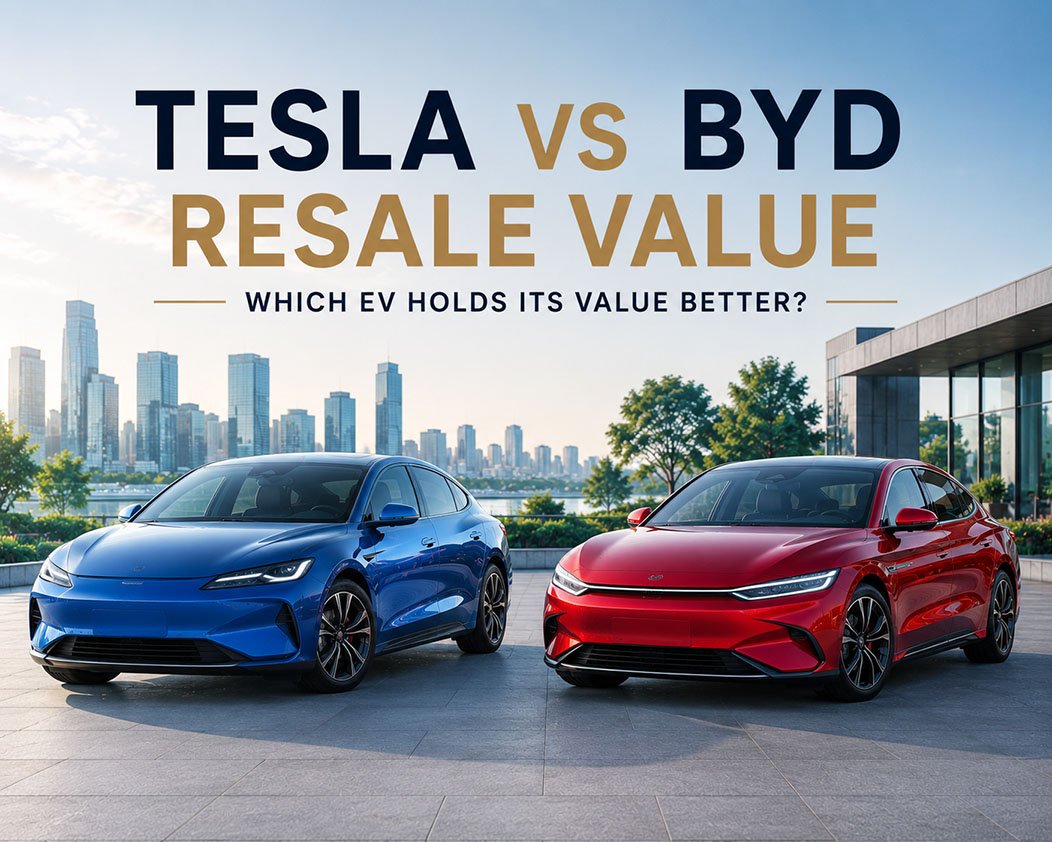
For many EV buyers, the real ownership cost is not only what the car costs today. It is how much value disappears when it is time to sell.
In many established EV markets, Tesla still carries stronger resale confidence than BYD, though that advantage now depends more on market maturity and pricing discipline than badge prestige alone. That edge is not just about brand cachet. It comes from used-market familiarity, battery confidence, software reputation, charging ecosystem trust, and the simple fact that more second-hand buyers already know what a Tesla ownership story looks like.
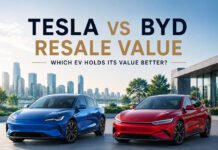
BYD is improving quickly as its global footprint expands, dealer coverage grows, and battery reputation becomes better understood outside China. But the used EV market is still evolving fast enough that resale confidence remains highly regional. The real question in tesla vs byd resale value is not who looks better on launch day. It is which car still feels easier to trust three or four years later.
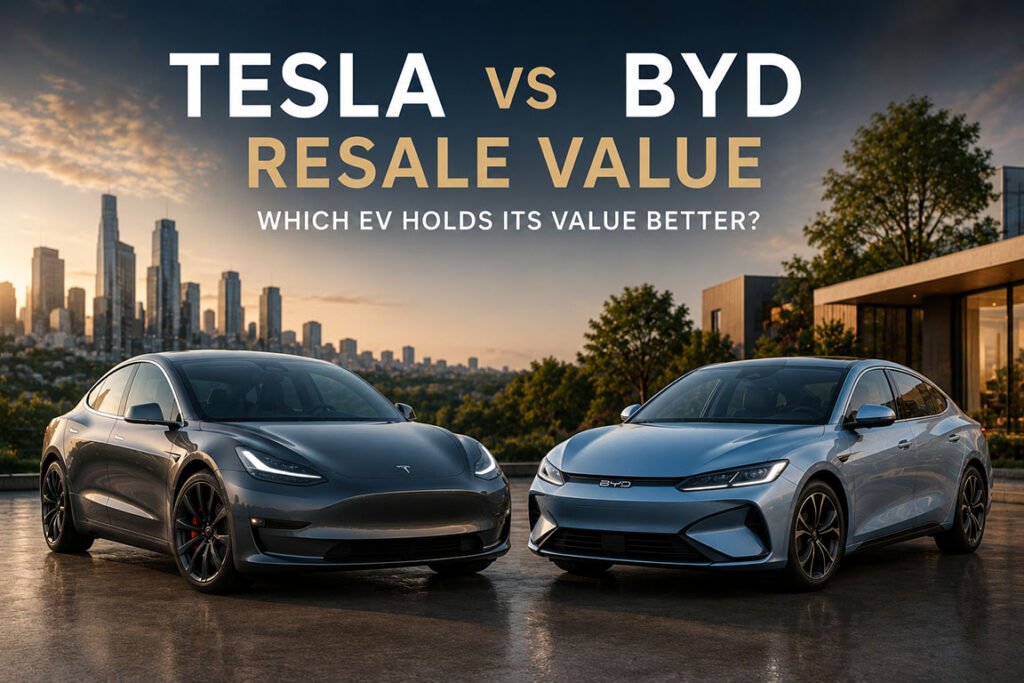
Editorial illustration discussing long-term EV resale value and ownership confidence
Why EV Resale Value Matters More Than Many Buyers Expect
Depreciation is one of the biggest ownership costs in any modern car, and EVs can make that cost feel sharper because pricing, incentives, battery perceptions, and technology all move quickly. A car that looks like strong value when new can look much less attractive later if software ages badly, charging feels inconvenient, or the market loses confidence in the badge.
That is why resale value matters more than many buyers expect. Strong resale can soften a high purchase price. Weak value retention can become one of the biggest hidden costs of EV ownership, especially when EV pricing shifts faster than buyers expect. For used EV shoppers, resale value is also a trust signal. It reflects how comfortable the next owner feels about battery life, support, software, and long-term usability.
Tesla vs BYD: Why This Comparison Matters in 2026
This is no longer a niche comparison.
Tesla remains one of the most recognizable EV brands in the world. BYD has become one of the biggest EV manufacturers globally and continues to expand in export markets. China remains the largest EV market by a wide margin, and BYD and Tesla have been among the industry’s most important global front-runners as EV competition has intensified.
That matters because buyers are no longer comparing Tesla only with legacy premium brands, and they are no longer treating BYD as an unknown curiosity. In more markets, the Tesla-versus-BYD decision is becoming a direct ownership question. Once the two brands start appearing in the same budget range, resale confidence stops being an academic point and becomes part of the buying case.
Tesla’s Biggest Resale Strengths
Tesla still has a few structural resale advantages that are hard to ignore.
The first is simple familiarity. Used-car buyers know what a Tesla is. They know the basic ownership story, they know the software-first identity, and they know the brand has been present in the used EV conversation for years. That reduces uncertainty, which is half the battle in resale.
Tesla also benefits from a large owner community, strong OTA awareness, and a charging ecosystem that still carries weight in buyer psychology. That matters because used buyers are often more comfortable with a car whose ownership story already feels familiar.
A used Tesla often feels easier to understand than a less familiar EV because the market already has a vocabulary for it. Recurrent’s business is built around helping buyers and sellers understand used EV value through battery and ownership data, which tells you something important by itself: used EV confidence is strongest where data, familiarity, and expectations are already mature.
None of that makes Tesla resale immune. Price cuts can hurt. Competition is stronger than it used to be. And older Teslas no longer sit in a market with fewer credible alternatives. Long-term buyer confidence is also influenced by reliability perception, which we explored in our Tesla vs BYD reliability comparison.
Buyers focused on the financial side of ownership should also compare resale value with long-term running costs. Our Tesla vs BYD Ownership Cost comparison explores how depreciation, charging expenses, maintenance, and insurance contribute to the total ownership equation.
BYD’s Biggest Resale Challenges and Opportunities
BYD’s resale story is more dynamic.
On the positive side, BYD is growing rapidly in visibility and ownership credibility. Its battery reputation helps, its model range is broad, and its global presence no longer looks theoretical. BYD’s UK network reached 125 dealership sites in 2025, a reminder that dealer growth can move fast when a brand commits seriously to a market. That kind of expansion matters because resale confidence usually follows support, not press releases.
On the other hand, BYD still has a shorter used-market history than Tesla in many regions. Buyers may like the new-car value proposition while still hesitating over used prices, long-term support, or parts confidence. Aggressive pricing helps sell new cars, but it can also make the next buyer wonder what the equivalent new car will cost in another year. That uncertainty does not make BYD weak. It just means BYD resale value is still less settled than Tesla resale value in many established EV markets.Used-market confidence is closely tied to long-term ownership trust, which we discussed in our guide to Are cheap Chinese EVs reliable long term.
Battery Confidence Plays a Huge Role in EV Resale Value
For many used EV buyers, battery confidence matters more than mileage alone.
Tesla benefits from a very large real-world ownership base. That gives buyers more examples, more long-term stories, and more confidence that battery behavior is broadly understood. BYD benefits from rising confidence around Blade Battery branding and LFP chemistry, both of which help the brand make a cleaner durability argument than some buyers might expect from a rapidly expanding EV manufacturer. BYD’s regional warranty materials also frame the battery as a core part of the ownership proposition, though exact coverage still has to be checked by market and model.
The key point is not that one brand has a magic battery. It is that resale strengthens when used buyers believe the battery will remain usable, supportable, and financially low-drama years later. Recurrent says it analyzes millions of real-world miles and focuses on helping people buy, sell, and understand EVs with confidence. That is exactly why battery confidence affects resale so much: uncertainty is expensive.
For many buyers, battery health is the single biggest unknown when purchasing a used EV. Our guides on hhow long EV batteries really last and what battery degradation actually looks like provide useful context for understanding why battery confidence has such a strong influence on resale value.
Price Cuts Can Hurt EV Resale Values
This is where resale value stops being a theory and starts being painful.
Tesla has already shown how quickly price cuts can reset used-market expectations. That does not mean Tesla resale weakened everywhere. It simply means pricing stability matters more to used values than many owners expect. It does mean pricing stability matters. If buyers think the next new Tesla could be meaningfully cheaper again, some used values will feel that pressure. At the same time, market reporting has also shown that used Tesla prices do not move in one clean direction forever. Some segments stabilize. Some recover. Some do not. Resale is not a straight line.
BYD faces a different version of the same issue. A lower entry price can reduce depreciation pain in one sense, because there is less money to lose in absolute terms. But aggressive affordability can also compress used values if the next new-car price looks even more tempting. Product quality matters, but pricing discipline matters too. A good EV can still depreciate hard if the market loses confidence in where new-car pricing is heading.
Real-World Depreciation Trends: Tesla vs BYD
Looking at resale value in theory is useful, but real-world depreciation trends tell a more practical story.
Tesla has accumulated a much larger used-EV history than BYD in most mature markets. That longer track record creates more confidence among buyers because resale pricing patterns are easier to understand. Even after several rounds of price cuts, buyers generally know what a used Tesla is worth and what ownership experience to expect.
BYD faces a different challenge. The company is growing rapidly, but in many markets its used-car history remains relatively short. Buyers have less long-term pricing data, fewer examples of older vehicles, and less familiarity with how specific models perform after several years of ownership.
This does not automatically mean BYD vehicles will depreciate faster. In some markets, strong demand and aggressive expansion have helped support used values. However, resale confidence often follows predictability, and Tesla currently benefits from having a much larger pool of real-world ownership and pricing data.
As BYD expands its dealer network, increases brand recognition, and builds a longer ownership history, the resale gap could narrow. For now, Tesla generally holds the advantage in resale predictability, while BYD remains the more developing story.
Tesla vs BYD Resale Value Factors
| Factor | Tesla | BYD |
|---|---|---|
| Brand recognition | ✓ Stronger: Very strong in many mature EV markets | ↗ Improving: Growing quickly, but still less established in some used markets |
| Used market maturity | ✓ Stronger: Broader pool of listings and higher buyer familiarity | ↗ Improving: More market-dependent and still developing in several regions |
| Market data availability | ✓ Stronger: Longer ownership history and more established used-EV pricing data | ↗ Improving: Growing rapidly, but historical resale data remains limited in many markets |
| Battery confidence | ~ Mixed: Benefits from large real-world ownership history | ~ Mixed: Benefits from Blade Battery and growing LFP confidence |
| Software reputation | ✓ Stronger: Strong OTA and ecosystem awareness | ~ More variable: Varies more by model and region |
| Charging ecosystem | ✓ Stronger: Strong association with charging convenience | ~ More variable: More dependent on regional infrastructure and third-party networks |
| Pricing stability | ~ Mixed: Can be affected sharply by direct price cuts | ~ Mixed: Aggressive value pricing can pressure used expectations |
| Dealer/service support | ~ Market-dependent: Strong in some markets, criticized in others | ↗ Improving: Improving, but still uneven by country |
| Resale predictability | ✓ Stronger: Usually stronger in mature Tesla markets | ↗ Improving: Improving, but still less predictable in newer BYD markets |
| Overall resale outlook (2026) | ✓ Stronger today: More predictable resale environment in most mature EV markets | ↗ Improving rapidly: Could narrow the gap as ownership history and dealer networks expand |
A practical ownership-focused video on EV depreciation, pricing pressure, and used-market value trends.
Software and Charging Ecosystem Affect Used-Car Confidence
A car that still feels current after several years is easier to sell.
That is one of Tesla’s quiet resale advantages. Even buyers who are not emotionally attached to Tesla usually understand the software story: over-the-air updates, route planning, familiar app integration, and a strong association with charging convenience. That helps older Teslas feel less outdated in the used market.
BYD’s position is improving, but it varies more by region and by how well local charging and software expectations line up with the ownership reality. Used buyers do not evaluate software like journalists do on launch day. They ask a simpler question: does the car still feel modern, usable, and easy to live with? Software quality and charging convenience also shape the EV charging experience especially in long-term ownership.
Dealer Networks and Service Support Also Affect Resale
A technically good EV can still struggle in the used market if aftersales support is weak.
Parts availability matters. Warranty handling matters. Dealer competence matters. Buyers are not just asking whether a car is good when new. They are asking whether it will still be fixable, supportable, and sensible to own if something goes wrong in year four. BYD’s expanding dealer presence is relevant here because stronger local support usually helps resale confidence. MG’s long warranty messaging matters for the same reason: used buyers notice support signals.
Tesla and BYD both face service criticism in some markets, which is why resale strength is never universal. A brand with strong support in one country can feel much riskier in another. Used buyers price that uncertainty in quickly, which is why weak local support can damage resale even when the car itself is fundamentally good.
Which Buyers Should Prioritize Resale Value Most?
Resale value matters most when the buyer expects ownership to be a phase, not a decade-long commitment:
- are financing the car
- expect to upgrade in three to five years
- care about total ownership cost more than launch-day emotion
- are entering EV ownership for the first time
- are shopping used and want to avoid value traps
It matters less for:
- buyers planning to keep the car for 10 years or more
- owners focused mainly on upfront affordability
- drivers whose main priority is minimizing today’s monthly outlay
That does not mean long-term owners should ignore resale. It means resale becomes less decisive when the car is likely to stay in the household long enough for depreciation pain to spread itself out over more years.
Tesla vs BYD Resale Value: Which EV Holds Its Value Better?
In many established EV markets, Tesla still holds the stronger resale advantage.
If your priority is resale confidence today:
Tesla remains the safer choice. Its larger ownership base, stronger buyer familiarity, broader charging ecosystem, and longer used-market history create a more predictable resale environment.
If your priority is buying value today and betting on future brand growth:
BYD becomes a more interesting proposition. As dealer networks expand, brand recognition grows, and ownership data accumulates, its resale position could strengthen significantly over the coming years.
That advantage comes less from badge prestige than from used-market maturity, buyer familiarity, software confidence, charging ecosystem trust, and a longer real-world ownership history. In practical terms, a used Tesla often feels easier for the next buyer to understand.
But BYD is improving quickly. As global awareness rises, dealer networks expand, battery confidence grows, and the brand becomes more familiar outside China, its resale position should become more credible in more markets. The gap is not fixed forever. It is still shaped by local support, pricing discipline, and how much trust BYD can build in the used market over time.
The smartest buyers should not look only at today’s purchase price. They should ask which car is more likely to remain easy to trust, easy to support, and easy to sell once the excitement of the new-car deal is gone.
Resale value is ultimately a measure of trust. The easier the next buyer feels about purchasing your car, the stronger its resale position is likely to be.
FAQ
1. Does Tesla have better resale value than BYD?
In many mature EV markets, usually yes. Tesla still benefits from stronger buyer familiarity and a more developed used market, though the gap is not fixed if BYD continues to expand support and build trust.
2. Why do EVs depreciate quickly?
Because pricing changes fast, technology evolves quickly, and buyers still worry about battery life, software support, and long-term confidence.
3. Does battery degradation affect resale value?
Yes. Even when a car remains fully usable, buyer concern about battery health can affect used values.
4. Are Chinese EVs harder to resell?
Sometimes, especially where the brand is still new or local support is limited. It varies a lot by market and by how established the badge is.
5. Does Tesla’s charging network help resale value?
It can, because used buyers often associate Tesla with easier charging and a more familiar ownership ecosystem.
6. Will BYD resale values improve over time?
They may, especially as dealer networks, market familiarity, and long-term ownership trust improve in more regions.
7. What matters most for EV resale value?
Battery confidence, pricing stability, software support, charging ecosystem trust, service support, and used-market familiarity all matter.
8. Does Tesla’s frequent price cutting hurt resale value?
It can. Large manufacturer price reductions often place downward pressure on used-car prices because buyers compare used vehicles with newly discounted alternatives. However, resale value is influenced by many factors beyond pricing alone, including brand trust, charging convenience, software support, service infrastructure, and overall market demand.