













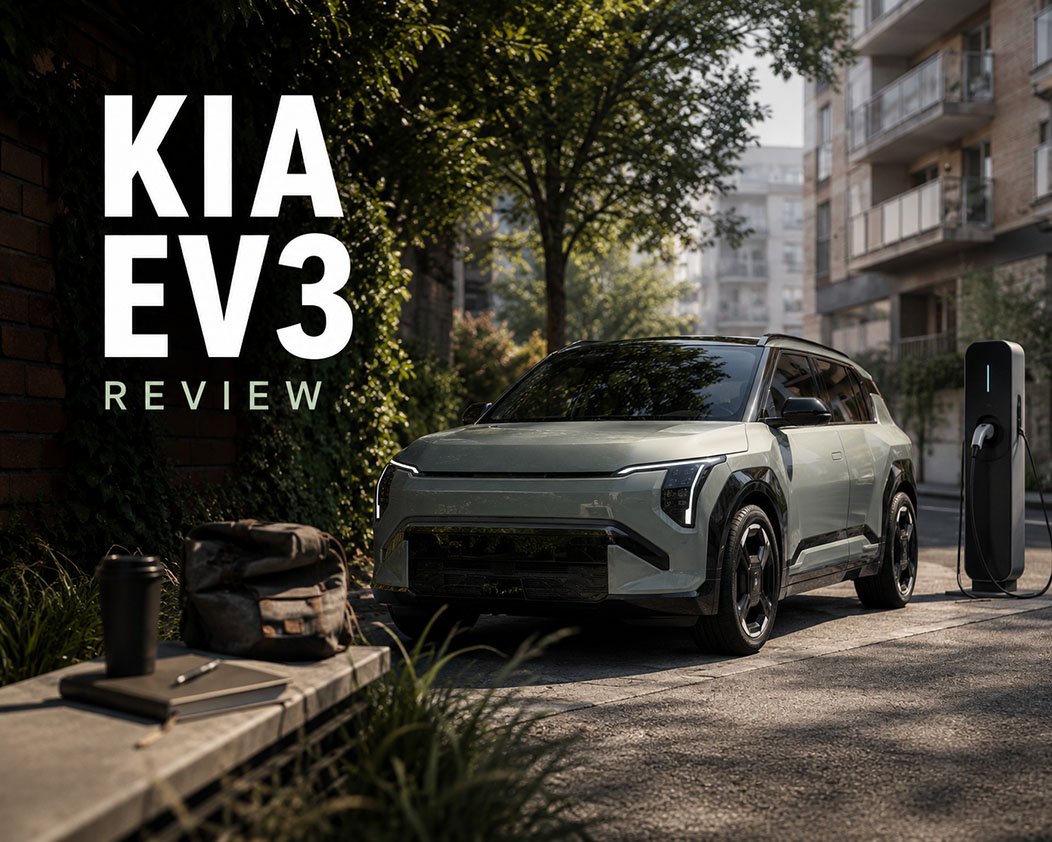
The EV market is crowded with cars that try hard to impress in the first ten minutes. Bigger batteries, faster acceleration, flashier tech, more dramatic styling. The Kia EV3 appears to be chasing something else. It looks like a compact EV designed around routine rather than spectacle: manageable size, sensible charging, strong efficiency, and the kind of packaging that matters more on a Tuesday commute than in a launch video. Kia’s published specs back up that impression, with two battery sizes, competitive 10 to 80 percent DC charging times, and dimensions that stay compact enough for urban life.
That makes the EV3 more interesting than it first appears. For many buyers, usability and charging convenience matter more than acceleration figures. A compact electric SUV that is easy to park, efficient enough not to feel thirsty, and practical enough not to become irritating could matter more in real ownership than one more EV trying to win the internet on headline numbers alone. At roughly 4.3 metres long and 1.85 metres wide, the EV3 lands in the part of the market where compact dimensions still make everyday urban and suburban ownership meaningfully easier.
Kia EV3 Design: Compact but Modern
The EV3’s design is modern in the current Kia way: upright enough to feel like a crossover, clean enough to look current, and compact enough not to pretend it needs the road presence of a much larger SUV. Official Kia specification pages list overall length around 4,300 mm, width at 1,850 mm, and height around 1,560 to 1,570 mm depending on version.
That compactness matters more than styling theatre. In real ownership, a car like this has to fit narrow streets, smaller parking spaces, and the constant low-level friction of urban driving. The EV3 seems built with that in mind. Kia’s Turkish specs also list a turning circle of 5.19 metres, another clue that maneuverability was part of the brief.
The styling itself will not work for everyone. Kia’s EV design language is angular and deliberately futuristic, and design trends that look fresh at launch do not always age predictably. But the basic proportions are sensible. That matters more than whether every crease still looks fashionable in five years.
Interior Practicality and Daily Comfort
The EV3 makes more sense the moment you stop treating it as a styling exercise and start judging it by the standards of everyday transport.
Kia’s official materials point to a wide-screen dashboard layout, useful cabin storage, and family-friendly luggage space rather than some attempt to imitate a luxury car. Kia’s Turkish and Australian materials list a 12.3-inch driver display, a 12.3-inch infotainment screen, and a 5.3-inch climate-control interface, along with everyday conveniences like parking sensors, reversing camera, and smartphone integration depending on market and trim.
That is the kind of detail that matters in daily use. Rear-seat usability, access, cabin storage, and clear ergonomics make a bigger difference in a compact family EV than one more talking point about digital minimalism. The EV3 appears to understand that. Its cabin concept looks built around everyday clarity rather than novelty for novelty’s sake.
Cargo space also looks competitive for the class. Kia’s technical and brochure materials point to about 460 litres of luggage space, with a small front storage area in some published versions.
Its compact footprint and urban-friendly layout could also help the EV3 appeal to buyers researching the best EVs for apartment living.
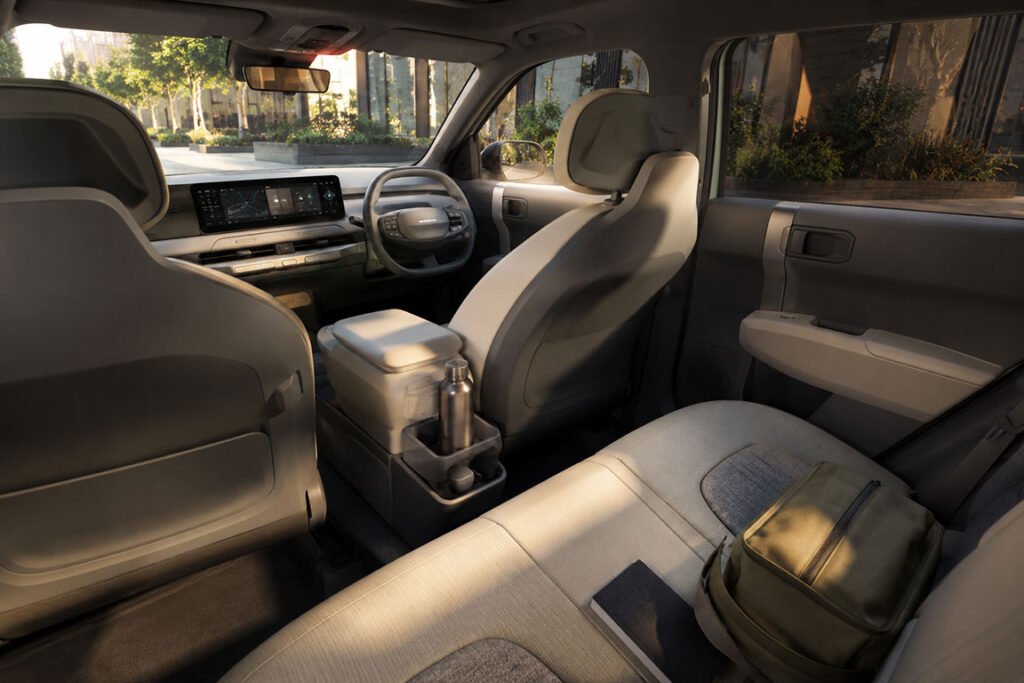
Editorial illustration discussing compact EV cabin usability, rear-seat practicality, and everyday storage design.
Charging Experience and Real-World Convenience
This is one of the sections that matters most, because EV ownership is often easier or harder depending on charging routine, not brochure claims.
Kia’s official specification pages are fairly clear on the headline figures. UK and European material says the EV3 can charge from 10 to 80 percent in around 29 minutes for the smaller battery and around 31 minutes for the long-range version on higher-power DC charging, while AC charging is rated at 11 kW. Kia also makes the usual but important point that actual charging depends on charger capability, battery condition, and surrounding conditions.
That is the right way to think about it. In real ownership, charging convenience matters more than peak charging numbers because routine is shaped by charger access, charging curve, and how naturally the car fits into the week. A compact EV that recovers time sensibly and integrates well into a normal weekly routine can be easier to live with than a larger car whose theoretical advantages do not show up in ordinary ownership.
For buyers without home charging access, the overall EV charging experience and realistic apartment EV charging setup options matter just as much as official charging specifications.
This is also where the EV3’s size and efficiency matter. A lighter, more efficient, less bulky EV reduces charging friction simply by needing fewer charging stops in the first place. That can matter more in daily life than one extra talking point about maximum range. The caveat is obvious: public-charging quality still varies heavily by region. The EV3 may be well judged, but it cannot fix weak infrastructure by itself.
A real-world Kia EV3 video focused on daily driving, charging behavior, and how the car fits normal ownership use.
Kia’s official EV3 specifications are useful here because the published charging times and battery choices show that the car’s case rests on sensible recovery and everyday usability rather than headline drama, which is exactly why Kia’s official EV3 specification pages matter more than generic social media claims.
Efficiency and Real-World Range
Efficiency is often a more useful ownership metric than battery size, especially for drivers who do not want every week to revolve around charging.
Kia’s published numbers suggest the EV3 should have a strong case here. Turkish and UK materials list WLTP efficiency and range figures that stretch from the low-to-mid 14s to mid-15s kWh/100 km depending on wheel and battery combination, with maximum published range as high as 375 miles in the UK or just over 600 km WLTP in some European-market long-range versions.
Real-world range will vary with speed, temperature, terrain, and driving style, as always. But the larger point holds: In daily ownership, a highly efficient EV can feel easier to live with than a larger car that promises more range but asks more often for charging time, space, and energy. It charges less often. It asks less from public infrastructure. It makes routine ownership feel lighter.
Efficiency and charging behavior can also influence long-term battery aging, especially when discussing how long EV batteries really last.
Winter will still matter. Cold weather reduces efficiency and stretches charging time. But an efficient compact EV has a better chance of staying practical in those conditions than a larger, thirstier one that needs more energy simply to maintain the same routine.
Is the Kia EV3 Good for Apartment Living?
Potentially, yes. In fact, apartment and urban ownership may be one of the clearest reasons the EV3 makes sense.
The EV3’s compact dimensions, manageable parking footprint, and sensible charging claims make it easier to imagine in apartment or urban use than many larger electric SUVs. Its size, turning circle, and efficiency all suggest a car that is big enough to function as a family vehicle while still being small enough not to become annoying in city life.
This matters because apartment EV ownership is rarely about perfection. It is about reducing friction. Easier parking, better efficiency, and decent charging recovery all help. So does route-planning clarity and software usability, assuming Kia’s implementation proves as usable in real life as its layout suggests on paper.
The caveat is still infrastructure. The EV3 could fit urban and apartment lifestyles better than many larger electric SUVs, but no car can fully compensate for poor local charging coverage or unreliable public chargers. In a well-covered city, the EV3 looks like the sort of car that could make electric ownership feel sensible. In a weak charging environment, it would still ask for patience.
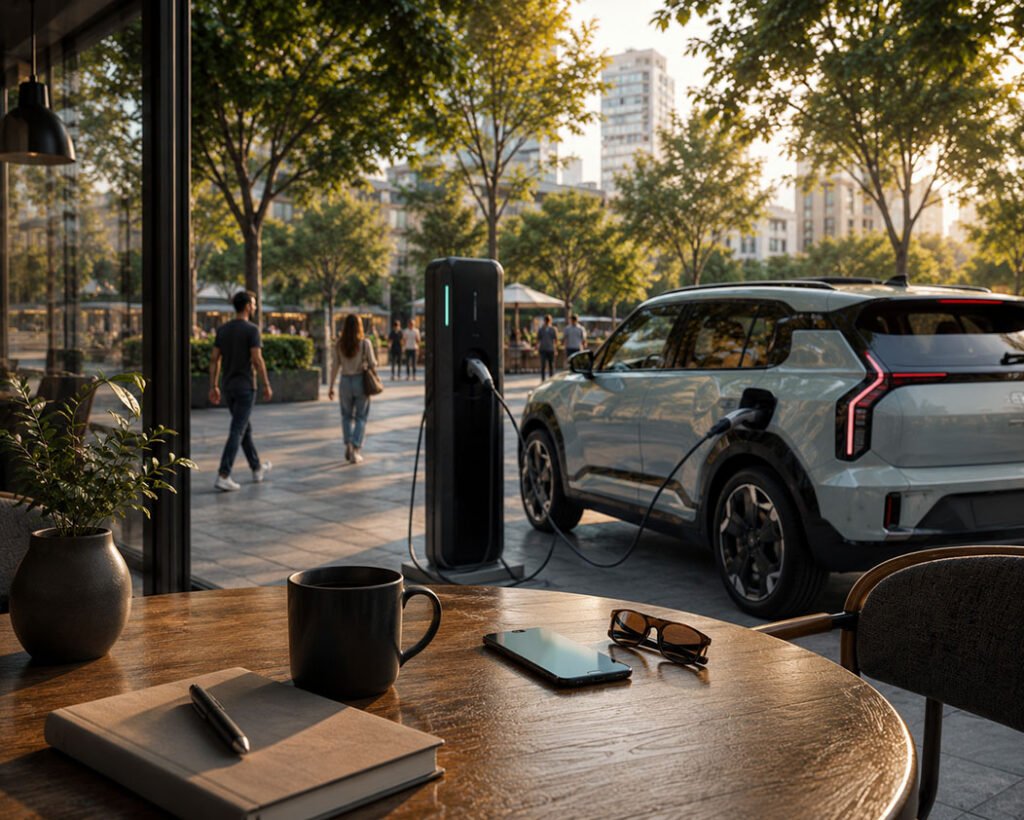
Concept image discussing public charging convenience, urban routine, and compact EV ownership.
Driving Experience: Comfortable or Sporty?
Everything about the EV3 suggests comfort and usability matter more here than theatre.
Kia’s published specs list 150 kW and 283 Nm for the versions already on sale in Europe and Turkey, with 0 to 100 km/h times in the mid-to-high seven-second range depending on version. That is plenty for daily use. It is also a useful reminder that the EV3 does not need to be a sports car to be convincing.
The more relevant question is whether the EV3 feels relaxed enough to make commuting easy. On paper, the answer should be yes. The proportions, crossover stance, and practical brief all point toward a car built for clean urban progress rather than aggressive personality. That is exactly what many buyers should want from a compact electric SUV.
If anything, that may be part of the EV3’s appeal. It does not appear to be chasing excitement as hard as some rivals. It seems more interested in being easy to live with.
Kia EV3 vs Other Compact EVs
The EV3 makes the most sense when you compare ownership logic rather than brand mythology.
Against a Tesla Model 3, the Kia’s argument is not outright tech dominance or charging-network advantage. It is hatchback-crossover practicality, a more upright seating position, and a package that may suit urban buyers better. Against the Hyundai Kona Electric, the comparison becomes more internal: both aim at sensible everyday use, but the EV3 looks fresher in packaging and cabin concept. Against the Volvo EX30, the Kia appears to trade some premium-brand cachet for a more openly practical brief. Against cars like the BYD Dolphin or MG4, the questions become value, support confidence, and how much each buyer prioritizes packaging, price, and ecosystem maturity.
Long-term EV ownership cost and support confidence also matter when comparing newer compact EVs, especially as buyers ask whether cheap Chinese EVs are reliable long term.
The right comparison is not “Which one wins?” It is “Which one asks the fewest daily compromises for the way I actually drive?”
Who Should Actually Buy the Kia EV3?
The EV3 makes the most sense for buyers who care more about everyday ease than automotive theatre.
Apartment and Urban Drivers
This is one of the clearest audiences. The EV3 looks sized for people who deal with parking, narrower streets, and imperfect charging routines. It is easier to justify than a larger SUV when space is part of the ownership equation.
Daily Commuters
A commuter-friendly EV needs more than decent range. It needs predictable charging, good efficiency, and a cabin that does not become tiresome. On paper, the EV3 appears well aimed at exactly that kind of ownership.
Small Families
The cargo space, rear-seat usability, and crossover shape suggest a car that could cover school runs, shopping, and normal family transport without feeling oversized. Kia’s published 460-litre boot figure matters here more than any performance number.
First-Time EV Buyers
This may be one of the most relevant groups. The EV3 appears to offer a sensible mainstream EV experience without demanding that buyers embrace something oversized, overpowered, or overcomplicated.
Buyers Prioritizing Efficiency Over Performance
This is probably the EV3’s most natural audience of all. If someone cares more about how often they charge, how easy the car is to park, and how usable it feels than about launching hard away from traffic lights, the EV3 makes a lot of sense.
Potential Weaknesses Buyers Should Consider
The EV3 has a clear ownership brief, but that does not make it the right answer for every driver.
Charging convenience will still depend heavily on infrastructure quality. In a weak public-charging market, even a well-judged EV can feel compromised. Pricing will matter too, especially because compact EVs live or die by whether buyers feel the step up from cheaper alternatives is justified. Availability also varies by market, and Kia’s headline claims are region-specific, which matters if buyers assume every version gets the same numbers everywhere.
Winter efficiency will still be a limitation, as it is for every EV. And anyone looking for a genuinely sporty driving experience is probably looking in the wrong place. The EV3’s apparent strengths align with practical daily EV ownership, not performance-car expectations.
Kia EV3 Practical Ownership Overview
| Category | Strength | Potential Drawback |
|---|---|---|
| Urban driving | Compact footprint and easier maneuverability | Styling may not appeal to everyone |
| Charging | Respectable published 10–80% charging times | Real experience still depends heavily on infrastructure |
| Efficiency | Strong official efficiency claims for the class | Motorway and winter use will narrow the advantage |
| Interior practicality | Useful luggage space and sensible cabin packaging | Not presented as a luxury-car interior |
| Apartment living | Size and efficiency suit urban ownership | Still relies on local charging quality |
| Road trips | Long-range versions look credible on paper | Network quality and charging consistency still matter |
| Family usability | Practical compact-crossover layout | Larger families may still want more cabin space |
| Software and route planning | Modern digital layout and EV-focused interface | Final judgment depends on real-world execution |
Final Verdict: Is the Kia EV3 a Smart Everyday EV?
On paper, and in the way Kia has packaged it, the answer appears to be yes.
The Kia EV3 may become one of the more convincing compact EVs for buyers who care more about efficiency, charging convenience, daily comfort, and urban usability than about sheer performance. Its size makes sense. Its official charging and range figures are competitive. Its packaging appears practical rather than theatrical. Kia’s published data supports the idea that this car was designed around everyday use more than EV spectacle.
The final answer will still depend on price, region, charging infrastructure, and how well the software holds up in real ownership. But the EV3’s biggest strength may be that it feels less focused on EV hype and more focused on solving the practical realities of everyday electric-car ownership.
FAQ
1. Is the Kia EV3 good for daily driving?
It appears to be. The compact size, practical layout, and efficiency-focused brief all suggest strong everyday usability.
2. Is the Kia EV3 good for apartment living?
Potentially yes, especially because of its compact footprint and sensible charging figures, though local infrastructure still matters a lot.
3. How practical is the Kia EV3?
On paper, very practical. Kia lists around 460 litres of luggage space and a compact crossover footprint that suits everyday use.
4. Is the Kia EV3 efficient?
Official figures suggest it should be, with WLTP consumption published around the mid-14 to mid-15 kWh/100 km range depending on version.
5. How is the EV3 charging experience?
Kia’s official claims are promising, especially the published 10 to 80 percent times, but real-world experience still depends on charger quality and region.
6. Is the EV3 better for city driving or road trips?
Its strongest case appears to be everyday city and suburban use, though long-range versions should also be credible for longer trips.
7. Is the Kia EV3 family friendly?
For small families, yes. Its crossover format and luggage space suggest it should work well as a compact family EV.
8. Who should buy the Kia EV3?
The best fit is likely a buyer who values efficiency, compact practicality, charging convenience, and everyday usability more than straight-line performance.