














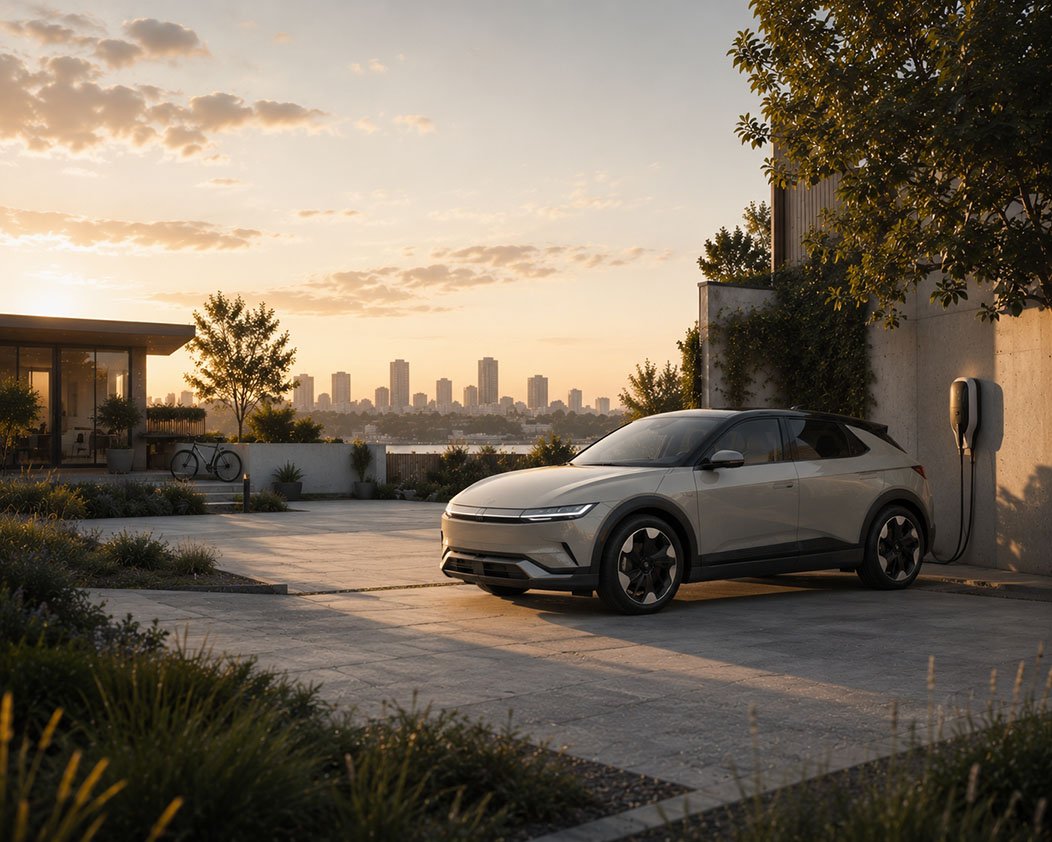
Some cars arrive with a headline. The Ioniq 5 arrived with a plan.
Few EVs have aged as gracefully as the Ioniq 5. What initially drew attention was the styling and charging technology. What kept the car relevant years later was something less glamorous: everyday usability. But what made the Ioniq 5 interesting then and what keeps it relevant now was never really about the spec sheet. It was about how sensibly the whole thing was put together. The flat floor, the practical cabin, the charging speed that actually fits into a real journey. These are the qualities that hold up after the initial novelty of a new EV has faded. And after several years on the market, the Ioniq 5 has had plenty of time to prove whether the original design philosophy was sound.
For 2026, Hyundai has refreshed the lineup in ways that feel less like chasing headlines and more like listening to the people who actually own one. Native NACS charging, a rear wiper that owners spent years requesting, wireless Apple CarPlay and Android Auto now standard, and a revised interior with physical buttons for commonly used functions.
None of it is dramatic. All of it is useful. That is a reasonable description of the Ioniq 5 as a whole a Hyundai Ioniq 5 review that matters most to those buying it, not those watching from the sidelines.
Why the Ioniq 5 Still Matters in 2026
The EV market has moved quickly in the years since the Ioniq 5 launched. The segment that once felt exclusive now stretches across every price point and body style imaginable. There are more options, more software-defined promises, more incremental range improvements announced every few months. Against that backdrop, it would be easy for a car like the Ioniq 5 to start feeling dated.
It does not feel dated.
What it feels like, instead, is settled. There is a meaningful difference between a car that is merely older and a car that has matured. The Ioniq 5 falls clearly into the second category. Fast charging remains one of the Ioniq 5’s biggest ownership advantages. Even several years after launch, many EVs still struggle to match the ease with which the Hyundai adds meaningful range during a normal road-trip stop. The ability to charge at up to 350 kW means that route planning on a longer drive is a practical consideration rather than an anxiety-inducing calculation.
The cabin proportions that wide, airy, flat-floor interior made possible by the skateboard architecture are still among the most usable in the segment. A lot of EVs have appeared since 2021. Not many have managed to feel this considered in the way they use their space.
Maturity also shows in how the 2026 updates were chosen. Adding a rear wiper is not exciting to write about. It is, however, the kind of thing that matters on a rainy morning when you want to see through the back window. Hyundai has been responsive to what owners found frustrating, and the 2026 model reflects that. That matters for buyers particularly for anyone looking at long-term ownership rather than a two-year lease.
Exterior Design: Retro-Futuristic Without Feeling Gimmicky
The Ioniq 5 still looks distinctive. That is not guaranteed for a car that arrived with strong visual opinions. Some designs that feel bold at launch start to look like period pieces within a few years. The Ioniq 5, to its credit, has not had that problem.
The pixel-inspired lighting elements, the flat surfaces, the sharp creases they draw on mid-century design references without imitating them too directly. It reads as considered rather than costumed. On the road it has real presence, particularly in larger configurations, though buyers in denser urban environments will want to be clear-eyed about the width before committing. This is not a narrow car.
The 2026 exterior tweaks are mild: revised front and rear bumpers, a reshaping of the rear spoiler, updated wheel designs. They tighten the original design slightly without disrupting it. The overall silhouette is the same car it always was. That feels like confidence in the original rather than hesitation to change it.
If the Ioniq 5 has a visual weakness, it is perhaps that the design language can read as emphatic in isolation but loses some of its intent in a busy parking lot or traffic. It rewards attention. That is a reasonable trade-off for a car that otherwise handles so many practical requirements so sensibly.
Interior Experience and Daily Usability
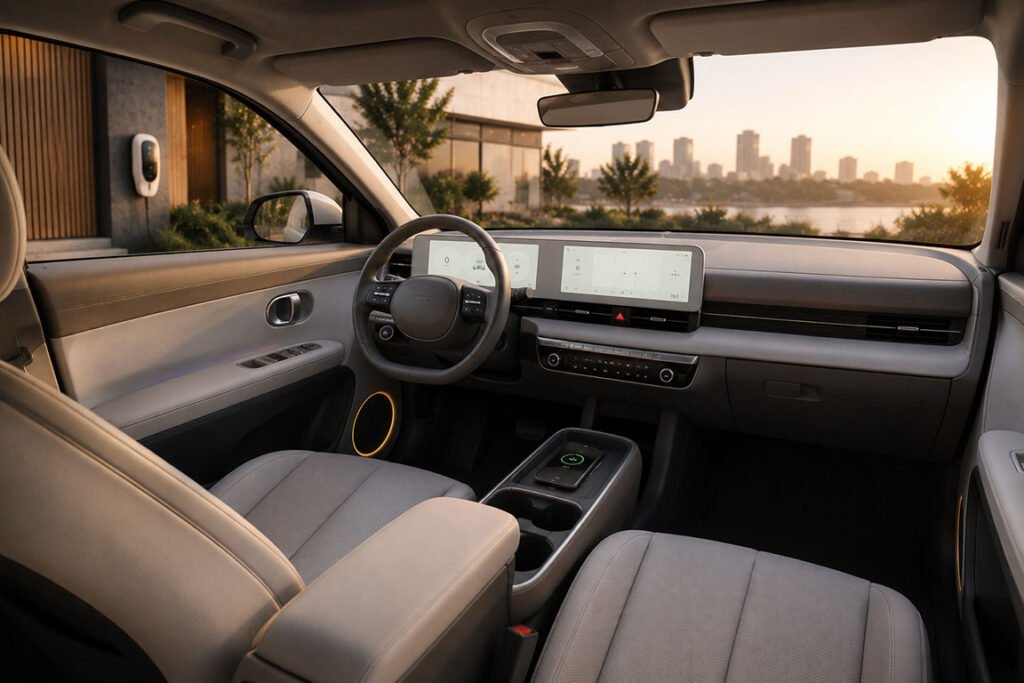
Editorial illustration exploring practical EV interior design and relaxed daily usability.
Some interiors are designed to impress during a test drive. The best interiors reveal their strengths six months later, when using the car feels effortless rather than memorable.
The Ioniq 5 belongs in the second category. The flat floor created by the E-GMP platform makes a genuine difference to how the cabin feels on a daily basis there is no transmission tunnel to work around, no compromise dictated by packaging that was designed for something else. The interior volume is genuinely generous for the car’s exterior footprint, particularly in the rear. Passengers have room to sit rather than fold themselves in.
The sliding centre console, which allows some adjustment of the front cabin space, is a minor practical detail that adds up over a long ownership period. The front storage areas are useful. Rear seat comfort is good for the class.
For 2026, Hyundai redesigned the centre console with physical buttons for seat heaters and other commonly used controls. This is worth noting because it addresses something that owners of earlier models found genuinely inconvenient touchscreen-only interfaces for climate and seat functions are fine in theory but slow in practice. Having tactile controls for the things you adjust most often is a more mature approach to interior design.
Hyundai largely avoided the temptation to turn the cabin into a giant screen. The displays are easy to read, but they don’t define the entire experience of the interior. The 2026 model runs Hyundai’s updated ccNC (Connected Car Navigation Cockpit) infotainment system, which brings wireless Apple CarPlay and Android Auto as standard across all trims, along with over-the-air update capability. The screens feel purposeful rather than theatrical.
Visibility from the driver’s seat is reasonable. The 2026 addition of a standard rear wiper, something earlier models conspicuously lacked improves the practical picture. Anyone who has owned an early Ioniq 5 in a wet climate will understand exactly why this matters.
Storage throughout the cabin is practical without being over-engineered. The frunk exists and is usable. Boot space is sensible. This is a family car that functions like a family car, which sounds obvious but is not always guaranteed when a manufacturer has prioritised other priorities.
Charging Experience and Road Trip Practicality
This is where the Ioniq 5 ownership argument remains genuinely strong.
The 800-volt architecture is not just a marketing specification. In daily ownership and on longer journeys, it translates into charging stops that feel genuinely brief. The real advantage isn’t a specific charging number. It’s the rhythm it creates. Long charging stops rarely become the dominant memory of a road trip, which is exactly what most owners want. You do not need to plan your journey around the car. The car slots into journey planning without becoming the main character of it.
The 2026 model adds native NACS (North American Charging Standard) charging as standard, allowing direct access to Tesla’s Supercharger network across North America without an adapter. This is a practical change to a real ownership problem. Tesla’s Supercharger network is extensive and generally reliable, and having access to it without additional hardware simplifies planning considerably. It is worth noting, however, that Supercharger speeds may not match those available at 350 kW Electrify America stations the hardware difference is real. Understanding that distinction helps set expectations more accurately than assuming all fast charging is equivalent.
Route planning with the Ioniq 5 works well in practice. The vehicle’s navigation system integrates charging stop suggestions, and the charging curve — the rate at which power tapers as the battery fills — behaves sensibly. Most experienced EV owners plan stops up to around 80% state of charge, which keeps charging speed near its peak and avoids the slower rates at higher battery percentages. The Ioniq 5 fits that rhythm comfortably.
Public charging reliability remains a wider infrastructure issue rather than a vehicle-specific one. Public charging daily EV use the consistency of available, working, fast chargers varies significantly by region. The Ioniq 5 is well-equipped for the charging that exists. Whether that charging infrastructure meets your particular needs depends on where you live and how you drive. That is a genuine consideration, and worth thinking about honestly rather than optimistically. Can you really live with only an EV is a question the Ioniq 5 helps answer positively for most buyers, but not universally.
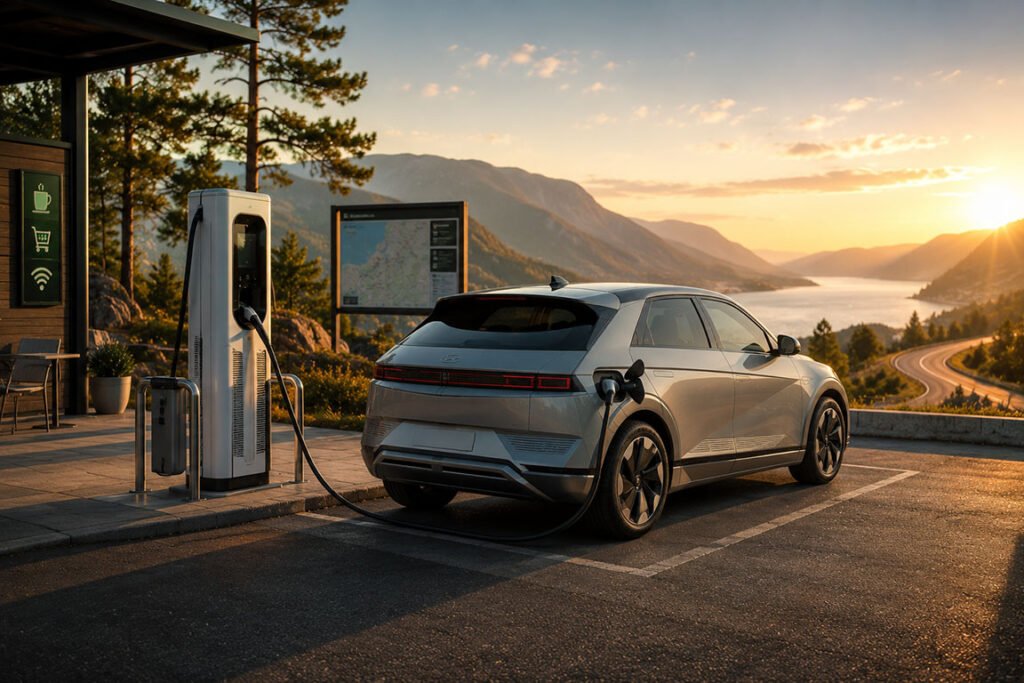
Concept image discussing EV charging convenience and road-trip usability.
Ioniq 5 ownership experience video
Ride Comfort, Driving Feel and Daily Character
The Ioniq 5 is not trying to be a sports car. That is not a criticism. It is a description of what Hyundai built and what it does well.
Ride quality is one of the car’s consistent strengths. The long wheelbase — possible because the battery fills the floor — contributes to a composed, settled feel on the highway. It absorbs surface imperfections without drama. On longer drives, that quality compounds. A car that does not tire its occupants on a motorway is doing something genuinely valuable.
Steering is accurate and reasonably weighted without being communicative in any meaningful way. This is a car designed around comfort and usability, and the driving feel reflects that. Around town it is easy to place. At highway speeds it feels planted.
One-pedal driving and regenerative braking feel well-calibrated. The regeneration modes can be adjusted, and the default settings feel natural without being aggressively grabby. This is an area where some EVs can feel uncertain or inconsistent, and the Ioniq 5 handles it without calling attention to itself.
Noise is well-controlled. Wind and road noise are adequately suppressed at highway speeds, and the powertrain itself is quiet throughout the range.
The AWD version, with its dual-motor setup producing around 320 horsepower, has noticeably stronger performance. The RWD configuration is more than adequate for ordinary use. Neither version feels like it needs more power — and neither feels like it is suppressing a desire to be something sportier than it is.
Real-World Efficiency and Range
Range figures for the 2026 Ioniq 5 vary by trim, drivetrain, and battery configuration. According to EPA estimates, the SE/SEL/Limited RWD trims on the Long Range battery (84 kWh gross) are rated at up to 318 miles. AWD variants carry a modest range penalty as expected, with estimates ranging from 259 to 290 miles depending on trim. The Standard Range version, with its smaller battery, is rated at around 245 miles. Always verify current figures at fueleconomy.gov or Hyundai’s official Ioniq 5 page, as numbers can vary by region and equipment.
Real-world range will be less than EPA estimates under most highway driving conditions, and meaningfully less in cold weather. A reasonable working assumption for highway driving above 70 mph in moderate temperatures is somewhere in the region of 80–85% of the EPA figure. In winter, cold battery performance can reduce range further — broadly consistent with other lithium-ion EVs in this class.
This is not class-leading efficiency. The Ioniq 5 is a moderately large, moderately heavy crossover, and the numbers reflect that. What compensates for it and compensates well is the charging speed. A car that can recover significant range in 20 minutes at a fast charger is less dependent on having large range reserves than a car that charges slowly. The two variables interact, and the Ioniq 5’s combination is more useful in practice than either figure in isolation would suggest.
If you’re wondering how battery longevity changes over years of ownership, our guide on how long EV batteries really last explains what owners should realistically expect.
For most owners who charge primarily at home or at workplace Level 2 chargers, real-world range is a comfortable, practical number. It is on extended road trips, in winter conditions, or in climates where charging infrastructure is sparse that planning becomes more important.
Apartment Living and Urban Ownership
Apartment living changes the EV ownership equation more than most buyers expect.
The Ioniq 5 works well for apartment dwellers who have access to reliable public charging or workplace charging. The 800-volt fast charging architecture means that a stop at a DC fast charger — even twice a week — is brief enough to be integrated into a routine without significant disruption. If you have that access, the car’s ownership experience is genuinely manageable.
If you do not have that access, it becomes more complicated. The Ioniq 5 does not offer a particularly easy path to Level 1 slow charging from a standard outlet. A full charge at 120V would take long enough to be impractical as a primary charging method. The assumption embedded in the car’s design is that you have access to Level 2 or faster charging at least several times a week.
Buyers without home charging should also explore our guide to the best EVs for apartment living before making a decision.
The car’s size is also worth considering honestly. It is wide. In tight urban parking structures, narrow street parking, or congested city environments, that width becomes a daily consideration. It is not uniquely wide for its class, but it is not a compact car, and buyers moving from smaller vehicles should factor that in.
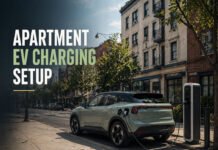
For a deeper look at practical charging solutions, see our apartment EV charging setup guide.
The Ioniq 5 suits apartment living best when charging access is reliable. For those who are still building their charging routine, the size and charging infrastructure dependence are real factors — worth thinking through before purchase rather than after.
Software, Tech and Long-Term Ownership Confidence
The 2026 Ioniq 5 runs Hyundai’s ccNC infotainment system. Wireless Apple CarPlay and Android Auto are now standard across the range — a meaningful upgrade from earlier models where wired-only projection was a genuine inconvenience. The system itself is responsive and logically laid out without trying to be everything at once.
Over-the-air (OTA) update capability is now present, which matters for long-term ownership. It means the car can receive software improvements after purchase rather than remaining frozen at the feature set of its build date. This is increasingly table stakes for EVs, and the Ioniq 5 now delivers it.
Driver assistance features have been expanded and refined. The 2026 model includes updated SmartSense driver aids — forward collision avoidance, adaptive cruise control with improved highway assist, blind spot monitoring, and a steering wheel-based hands-on detection system that works with highway driving assist. These systems are well-calibrated in ordinary use.
Long-term ownership confidence in Hyundai’s EV platform has been building. The E-GMP architecture has now been across multiple vehicles and multiple model years. Hyundai’s EV warranty — confirm current terms on the official Hyundai site, as coverage can vary by region — provides reasonable coverage for the battery and drive components. The car feels like a considered product from a manufacturer that has invested meaningfully in its EV foundation.
Hyundai’s software may not be the most ambitious in the segment, but it is mature, predictable, and easy to live with. For many owners, that matters more than having the flashiest interface.
Potential Weaknesses Buyers Should Know
No review that pretends a car has no weaknesses is worth reading. The Ioniq 5 has a few, and they are consistent enough to name directly.
Width in tight spaces. This is a wide car. In older urban environments, narrow parking structures, or tight street parking, that is a daily reality. It is not a deal-breaker for most buyers, but it should be a considered factor rather than a discovered one.
Efficiency is not class-leading. The Ioniq 5 is competent on efficiency, not exceptional. Buyers for whom maximum miles-per-kWh is the primary priority will find better options. As noted above, the fast-charging speed compensates for this in a practical sense, but it does not change the underlying number.
Charging infrastructure dependence. The car’s strengths are maximised when charging infrastructure is available and reliable. In areas where that is uncertain, the ownership case becomes more complex.
Software is capable but not the most advanced. If you want the most software-defined, feature-forward EV interface in the segment, the Ioniq 5 is probably not where you will find it. What it offers is solid and usable. What it does not offer is the sense of a perpetually evolving tech product.
Rear visibility on earlier models. The 2025 and 2026 refreshed models addressed the long-standing absence of a rear wiper. Buyers considering used examples from earlier model years — specifically pre-2025 — should be aware that older cars lacked this feature, and that visibility in wet weather was a genuine complaint. It is worth checking the build year carefully if purchasing used.
None of these are reasons to dismiss the car. They are reasons to buy it knowing what you are getting.
Who Should Buy the Ioniq 5?
It suits you well if:
- You have home charging or reliable workplace Level 2 charging access
- You take occasional road trips and want fast charging to feel like a non-event
- Interior space, comfort and rear-seat room matter to your daily use
- Ride quality and highway composure are more important to you than sporty handling
- You want a mature, settled EV ownership experience without constant software experimentation
- Fast DC charging speed is important for your routine or travel patterns
- You want one of the best charging experiences available outside the Tesla ecosystem
It may not suit you if:
- You park in very tight urban conditions where width is a daily problem
- You do not have reliable charging access and rely primarily on slow public infrastructure
- Maximum highway efficiency and range per kWh is your primary concern
- You want the most software-forward, technology-led EV experience currently available
- You are looking for a smaller, more compact electric vehicle
Hyundai Ioniq 5: Real-World Ownership Summary
| Ownership Area | Assessment | Notes |
|---|---|---|
| City driving | Good | Comfortable and easy to manage; width requires awareness in tight spaces |
| Ride comfort | Very good | Long wheelbase delivers composed, settled ride on highway and urban roads |
| Charging usability | Excellent | 800V architecture, NACS port, and ~18–20 min 10–80% DC charging make stops brief |
| Apartment living | Good with reliable charging | Works well with reliable public charging access; less straightforward without it |
| Road trips | Very good | Fast charging and NACS access to Supercharger network make longer journeys practical |
| Interior practicality | Very good | Flat floor, generous space, improved physical controls on 2026 models |
| Software usability | Good | Wireless CarPlay/Android Auto standard; OTA updates now available; not the most tech-forward in class |
| Efficiency | Moderate | Solid real-world numbers; not class-leading; fast charging compensates in practice |
| Family usability | Very good | Rear seat space, storage and comfort work well for families and longer journeys |
| Long-term ownership confidence | Good | Mature platform, OTA updates, refined over several model years; check Hyundai warranty terms by region |
Why the Ioniq 5 Still Feels Like a Thoughtfully Designed EV
The EV market rewards novelty. New platforms, new ranges, new software experiences arrive regularly, each announced as though ownership history doesn’t exist. Against that backdrop, the Ioniq 5 occupies an unusual position: it is a car that has had years to reveal whether its original priorities were sound, and the answer, in most of the ways that matter, is yes.
The flat floor is still one of the best in the segment. The 800-volt charging still delivers what was promised. The cabin still functions well after months of use rather than just impressing in a showroom. These are not small things. They are exactly the kinds of qualities that define whether a car is worth living with.
What the 2026 updates demonstrate is that Hyundai has been paying attention to owner feedback, to the changing charging landscape, to the small daily frictions that accumulate over a year of ordinary use. A rear wiper, physical seat heater buttons, wireless phone projection, NACS charging. These are not headline features. They are the edits that owners recognise and appreciate.
There will always be a newer EV. There is always a longer range claim, a faster software update, a more dramatic design statement arriving in a few months. The Ioniq 5 does not compete on those terms. It competes on what it is like to actually own one to charge it on a Tuesday morning, to load it for a weekend away, to hand it to someone who has never driven an EV and hear them say it was easy.
That may not sound exciting in a brochure, but it is exactly why the Ioniq 5 remains one of the smartest EV purchases you can make in 2026.
Is the Ioniq 5 Right for You?
Is the Ioniq 5 still worth buying in 2026?
Yes, for most buyers who want a well-rounded EV with strong fast-charging capability and a comfortable, practical interior. The 2026 model brings native NACS charging, wireless CarPlay/Android Auto, a rear wiper, and improved physical controls addressing the most common complaints from earlier model years. It is not the newest or most extreme EV on sale, but it remains one of the most complete packages for daily ownership.
Is the Ioniq 5 good for road trips?
Very much so. The 800-volt charging architecture, combined with 2026’s native NACS port giving access to Tesla’s Supercharger network, makes charging stops genuinely brief around 18–20 minutes from 10 to 80% at a compatible fast charger, according to Hyundai’s specifications. Route planning feels practical rather than stressful, and the comfortable cabin holds up well on longer journeys. EPA-estimated range varies by trim and drivetrain, so verify current figures for the configuration you are considering.
Is the Ioniq 5 good for apartment living?
It can be, but it depends on charging access more than the car itself. If you have access to reliable DC fast chargers or workplace Level 2 charging, the Ioniq 5’s fast-charging capability makes apartment ownership very manageable. Without that access, the dependence on public infrastructure becomes a more significant factor. The car’s width is also worth considering in dense urban parking environments.
Does the Ioniq 5 still feel modern inside?
The 2026 updates have meaningfully improved the interior experience. Wireless Apple CarPlay and Android Auto are now standard, the centre console has been redesigned with physical buttons for seat functions, and the updated ccNC infotainment system supports over-the-air updates. The dual 12.3-inch screen layout is well-integrated and not overwhelming. It does not have the most aggressively tech-forward interface in the segment, but it feels considered and usable which, for most owners, matters more.