
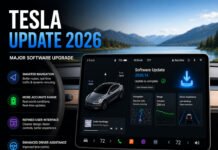















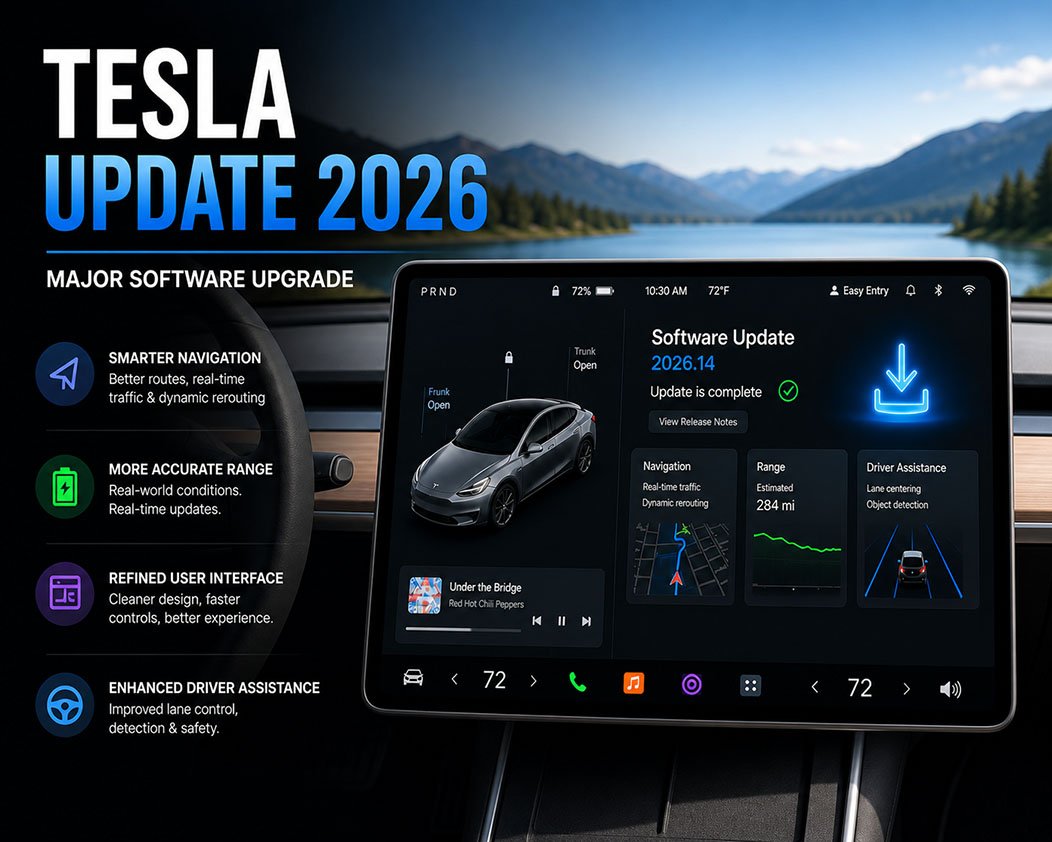
Tesla has announced a major software update for its 2026 electric vehicles, introducing improvements in range estimation, navigation intelligence, user interface design, and overall driving experience.
Unlike traditional automakers, Tesla continues to evolve its cars after purchase through over-the-air updates. This latest release is not just a minor tweak. It changes how the car behaves in everyday use.
For EV owners, that matters more than a spec sheet.
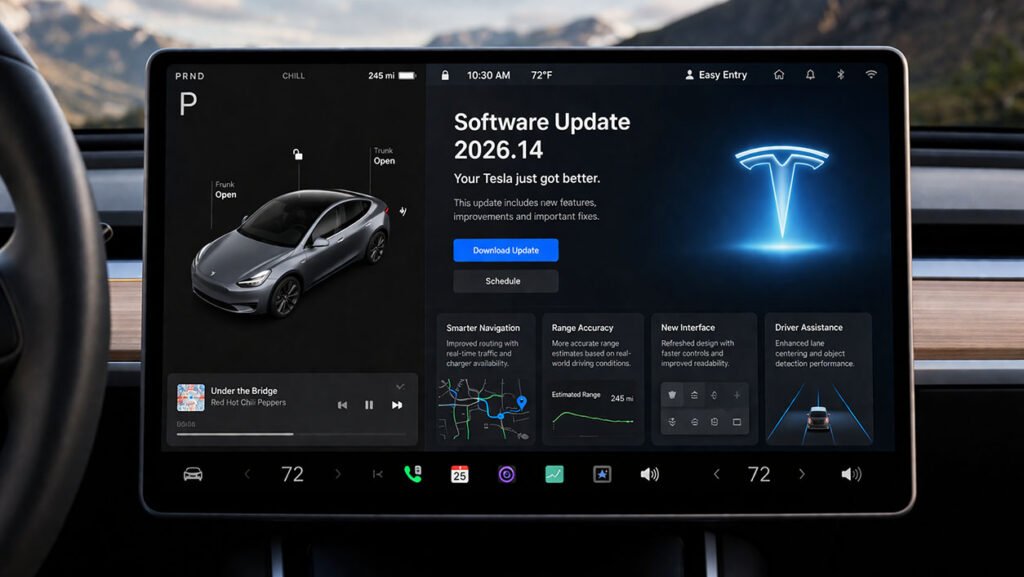
What’s New in the Tesla Software Update 2026?
Tesla’s 2026 update focuses on real-world usability rather than flashy gimmicks.
Smarter Range Estimation
Range anxiety is still the biggest barrier for many EV buyers. Tesla is improving how it calculates remaining battery range using:
- driving habits
- weather conditions
- elevation changes
- real-time traffic
This means fewer surprises and more accurate trip planning.
Video: Tesla Software Update Walkthrough
Improved Navigation System
Tesla’s navigation now integrates charging stops more intelligently.
New features include:
- dynamic charger rerouting
- real-time charger availability
- better long-distance route optimization
For drivers who travel often, this reduces planning friction significantly.
Refined User Interface (UI)
Tesla has redesigned parts of its interface to make it cleaner and easier to use.
Changes include:
- faster response times
- simplified menus
- improved media and climate controls
Minimalism still remains, but usability has improved.
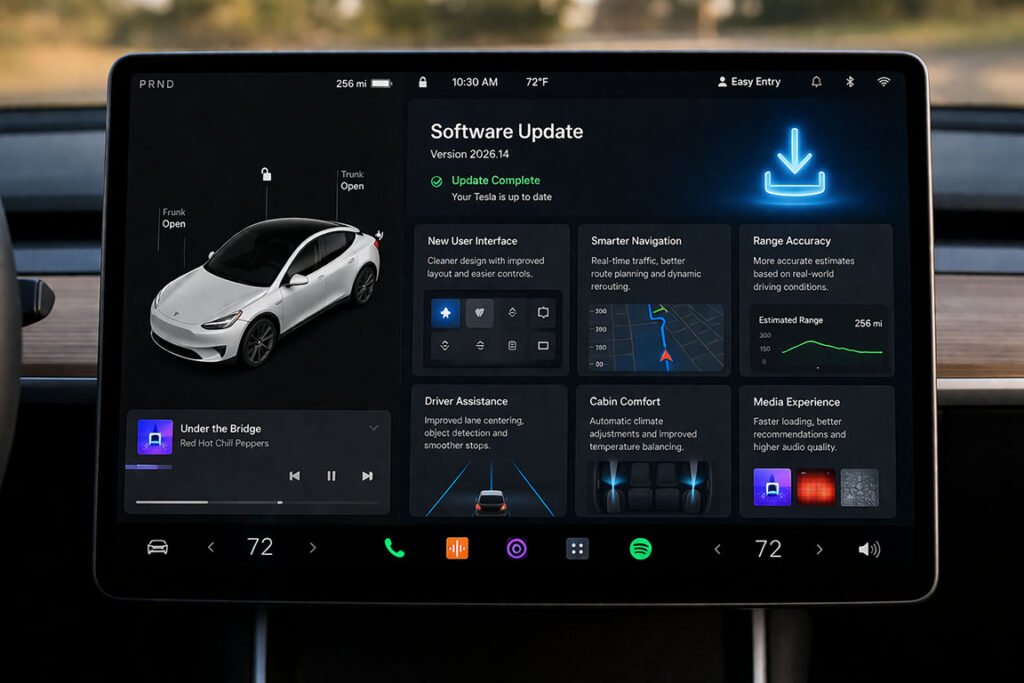
Expanded Driver Assistance Features
Tesla continues to push software-driven driving features.
The 2026 update improves:
- lane positioning accuracy
- smoother braking behavior
- enhanced object detection
While not fully autonomous, the system feels more natural and predictable.
Why This Update Matters for EV Owners
Most automakers treat software as an afterthought.
Tesla treats it as the product.
This update shows how EV ownership is changing. Instead of buying a fixed product, drivers get a platform that evolves over time.
That directly impacts long-term value.
If you’re comparing brands, read our BYD vs Tesla comparison for a broader perspective.
For official update details, visit Tesla’s website
How Tesla Compares to Other EV Brands
Tesla’s biggest advantage remains software integration.
Tesla vs Traditional Automakers
- Tesla → frequent OTA updates
- Traditional brands → slower updates, dealership visits
Tesla vs New EV Brands (BYD, Hyundai, etc.)
- Tesla → stronger software ecosystem
- Others → improving hardware and pricing
Tesla still leads in software polish, but competitors are catching up in other areas.
If you’re choosing a Tesla specifically, check our detailed Model Y Juniper review.
Real-World Impact of the Update
This update is not about specs. It’s about daily experience.
Drivers will notice:
- more accurate range predictions
- fewer charging surprises
- smoother driving assistance
- faster interface response
These small improvements add up.
Over time, they matter more than acceleration numbers.
How This Update Affects Resale Value
Tesla’s frequent software updates do more than improve daily usability. They also play a role in long-term resale value.
Unlike traditional vehicles that feel outdated after a few years, Tesla models continue to receive new features and refinements over time. This helps older vehicles remain competitive in the used market.
For buyers, this means the car you purchase today may still feel modern years later. For sellers, it can translate into stronger resale demand compared to EVs with limited software support.
This is one of the key reasons why Tesla ownership is often seen as a long-term value proposition rather than just an initial purchase decision.
Should You Care About This Update?
If you already own a Tesla, this update makes your car better without additional cost.
If you’re considering buying one, it reinforces Tesla’s biggest strength: software-first ownership.
But it also highlights something important.
Other brands are closing the gap.
Conclusion
The Tesla software update for 2026 is another example of how EVs are becoming smarter over time.
As software becomes the core of EV ownership, updates like this will play an even bigger role in how buyers choose their next car.
It improves real-world usability, enhances driving confidence, and strengthens Tesla’s position as a software leader in the EV space.
But the competition is evolving quickly.
In 2026, the EV market is no longer about who started first. It’s about who delivers the best ownership experience today.