







EV charging is usually discussed in the language of speed. Peak kW. Battery size. Minutes to 80 percent. Those numbers matter, but they are not what most owners remember.
What they remember is whether charging felt easy: whether the charger worked, whether the car guided them there properly, whether payment happened without friction, and whether the stop felt normal enough to fit into a trip instead of taking it over.
That is why EV charging experience matters more than spec-sheet culture suggests. Waiting 20 to 40 minutes is not automatically a problem. If the charger is reliable, payment is simple, the location is safe, and there is something useful nearby, the stop can feel perfectly tolerable. The frustration starts when the charger is occupied, the app fails, the billing flow is awkward, or the car arrives without properly preparing the battery for a fast charge. That is what actually shapes charging satisfaction in real life: not just how quickly power flows, but how little friction surrounds the stop itself.
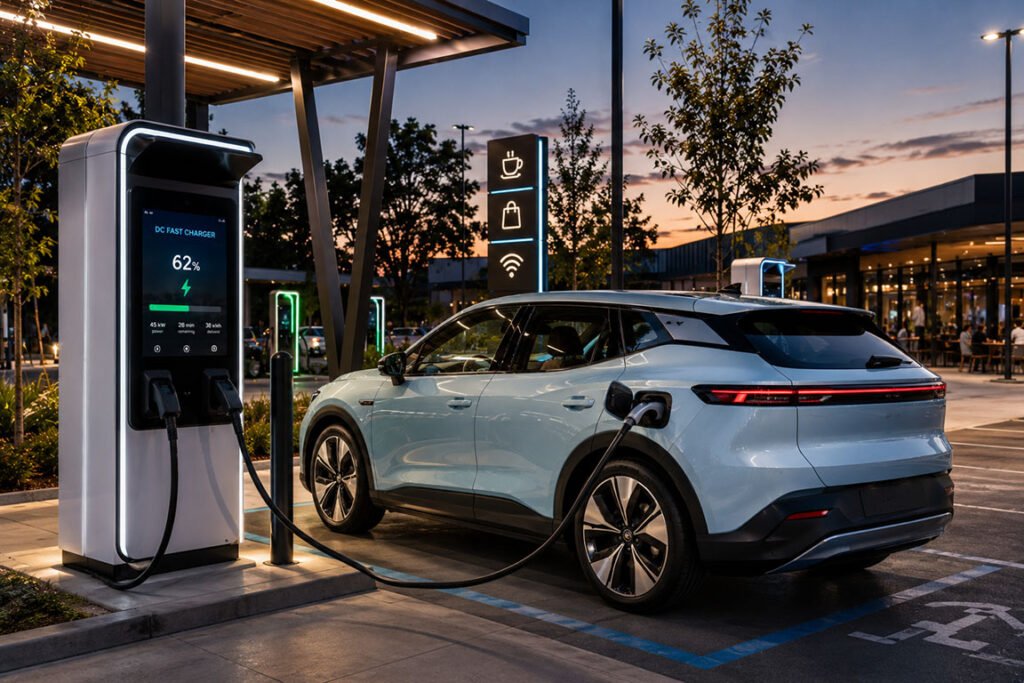
Electric car charging at a modern public EV charging station
Why EV Charging Experience Matters More Than People Think
Charging is not just an energy transaction. It shapes daily convenience, road-trip confidence, apartment living, public-charging habits, and overall ownership satisfaction.
A technically impressive EV can still feel annoying if the charging ecosystem around it is weak. A less dramatic EV with a more dependable network, better software, and simpler payment can feel easier to live with every week. That is the part buyers often underestimate.
The best charging experience is the one that makes the driver think about charging less.
This is also why charging an EV without a garage and hidden costs of EV ownership sit so close to this topic. Charging friction is not always about time alone. Sometimes it is about uncertainty. Sometimes it is about poor location quality. Sometimes it is about needing three apps, two accounts, and one unnecessary amount of patience just to start a session.
Charging Speed Is Only Part of the Story
High peak charging speed is useful. It just does not guarantee a good ownership experience.
A charger can look impressive on paper and still feel mediocre in practice. Peak numbers stop mattering very quickly when the charging curve falls away, the station is poorly lit, the app is clumsy, or the stop feels like a chore rather than a normal part of the journey. U.S. public-charging guidance increasingly frames the issue this way too: reliability, easier discovery, simpler access, and better station usability matter alongside raw charging speed.
What really shapes EV charging convenience tends to be a longer list:
- charger reliability
- real charging curve, not just peak kW
- ease of payment
- Plug & Charge support
- accurate charger availability
- battery preconditioning before arrival
- built-in route planning
- station location quality
- safety and lighting
- food, restrooms, Wi-Fi, or nearby amenities
- whether the charger actually delivers the expected speed
A fast charger in a bad location with poor uptime can feel worse than a slower charger in a useful place that works every time. That is the practical distinction too many charging discussions miss. A great EV charging experience is not the one with the biggest number on the charger. It is the one that makes charging feel predictable, simple, and almost forgettable.
Tesla: The Benchmark for Integrated Charging
Tesla still sets the benchmark for integrated charging, and the reason is not just charger speed.
Tesla’s charging and Supercharger support pages emphasize the full loop: built-in route planning, battery preconditioning before fast charging, simple plug-in charging, automatic billing, app-based charging status, and notifications while charging. Tesla also leans into in-car entertainment and nearby amenities, which may sound like a side note until you remember that boredom is part of charging experience too.
That is Tesla’s real strength. The car, the charger, the navigation, the payment, and the app usually feel like parts of one system rather than separate tasks. The advantage is ecosystem coherence, not magic.
That does not make Tesla perfect, and it should not be written like it does. Stations can still be busy. Peak-time congestion still exists. Experience still varies by region. Tesla also allows some non-Tesla EVs to use selected Supercharger locations in some markets, which broadens access but may also affect congestion depending on where you live and which stations you actually use. Tesla says non-Tesla access varies by market, location, and compatibility, and says it monitors sites for congestion.
So Tesla’s advantage is not that every stop is flawless. It is that the whole charging process usually feels like one system instead of a chain of separate tasks.
Tesla’s advantage is not necessarily faster charging hardware. The real advantage is that route planning, charger discovery, payment, battery preconditioning, and charging status all work together inside one ecosystem. Many competitors are now trying to reduce this gap through Plug & Charge support, network partnerships, and better software integration.
NIO: Battery Swapping Changes the Question
NIO remains one of the most interesting examples of a brand trying to solve charging by changing the question entirely.
Instead of asking how quickly the battery can charge, NIO asks whether the battery needs to be charged in the car at all. NIO says its Power Swap system can complete a battery swap in about three minutes where infrastructure is available, and says each swap includes checks on the battery and electric drive system.
That creates a very different ownership proposition. The experience becomes less about waiting for power and more about whether a swap station is nearby and integrated into your routes. For dense urban markets, fleets, taxis, and high-mileage use, that is a genuinely interesting alternative model.
But battery swapping only works well inside a tightly controlled ecosystem. It depends on compatible vehicles, brand-specific infrastructure, high station density, and serious capital investment. It is not easy to scale across all brands, all regions, and all ownership types. NIO’s own material makes clear how tightly the model is tied to its own Power Swap stations and vehicle ecosystem.
Battery swapping can feel better than charging where the network is dense and the vehicles are designed around it. Outside that kind of ecosystem, its advantages become much harder to reproduce at scale.
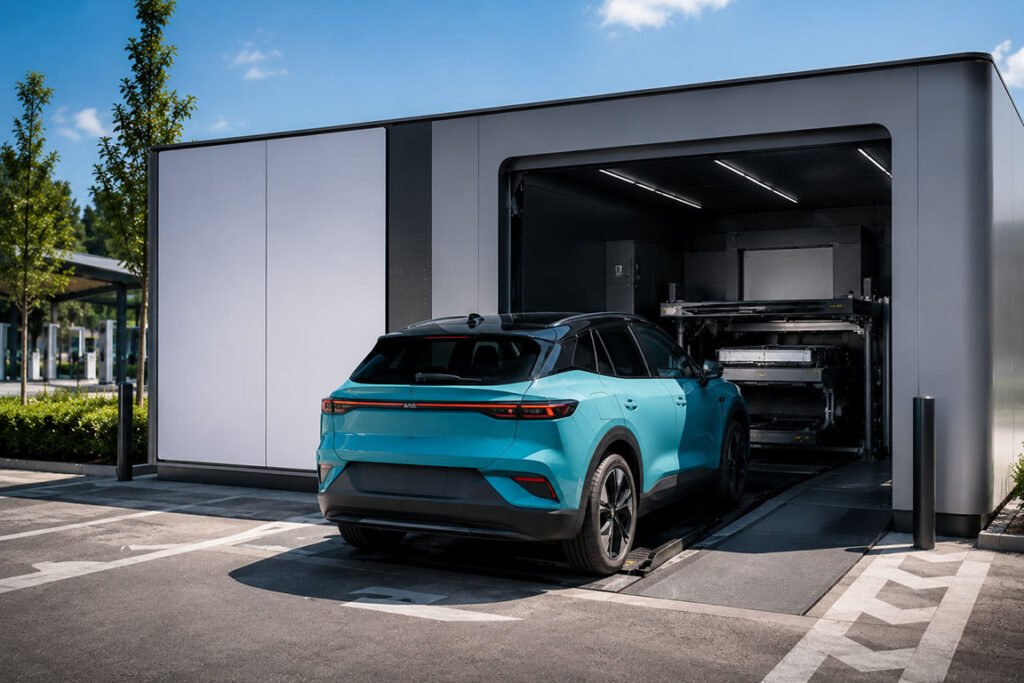
Electric vehicle battery swapping station for fast battery replacement
Rivian: Charging Built Around Trips, Not Just Stations
Rivian’s charging story is interesting because it is tied more closely to travel patterns than to generic network bragging.
Rivian’s official charging pages center the Adventure Network and broader route-planning ecosystem. Rivian says drivers can find charging in the app and in-vehicle navigation, and says Trip Planner can automatically route drivers through Rivian Adventure Network sites and compatible fast-charging stations. Rivian also says the Adventure Network is designed around R1T and R1S travel and, where available, can add meaningful range during relatively short stops.
That idea is sound. Charging feels better when the stop belongs to the trip rather than interrupting it.
The limitation is scale. Rivian’s approach is compelling, but coverage still matters more than philosophy. A strong concept only becomes a strong ownership experience if the chargers are actually where owners need them.
Mercedes-Benz: Premium Charging Only Works If the Coverage Is There
Mercedes-Benz is trying to make charging feel more premium, not just more powerful.
Its high-power charging strategy has focused on branded hubs, strong hardware, better waiting environments, and partnerships that make stops feel more intentional. Mercedes-Benz materials describe hubs near major routes and retail or service destinations, while Mercedes-Benz HPC pages emphasize amenities around charging locations and branded charging spaces.
That is a sensible angle for a premium brand. Comfortable waiting areas, better lighting, and useful nearby services do improve the experience when they are available.
But premium design does not solve a coverage problem. A beautiful charging hub is only useful if it exists on the routes people actually drive. Branding does not rescue a weak network footprint.
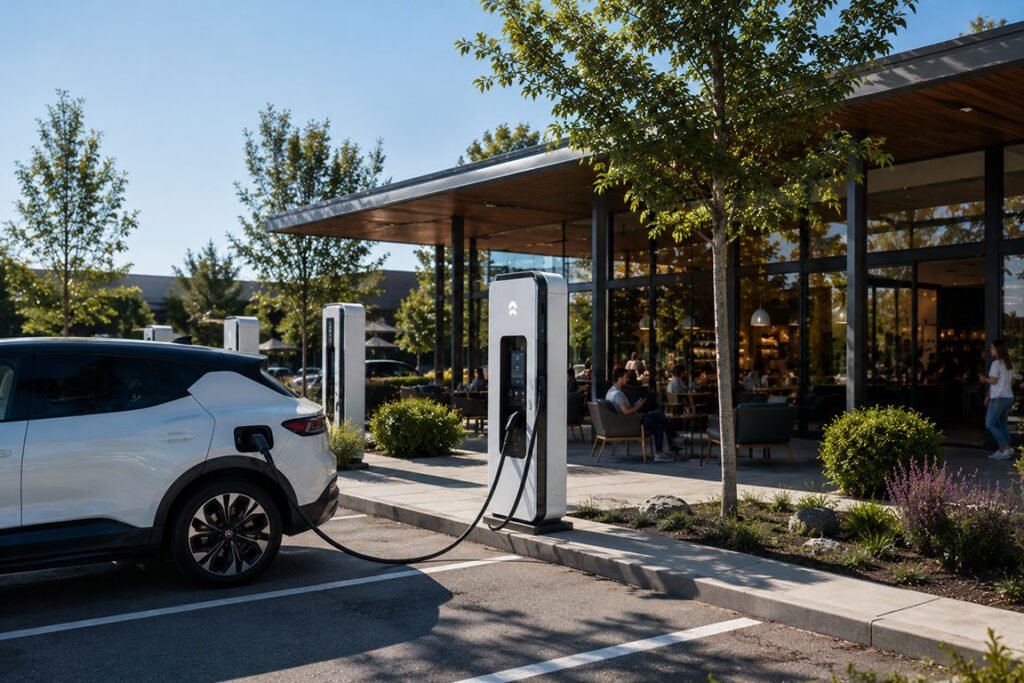
Electric vehicle charging hub with nearby amenities for drivers
Ford, Hyundai and Kia: Reducing Public Charging Friction
For mainstream buyers, the biggest improvement is often not a luxury hub. It is fewer steps.
Ford’s BlueOval Charge Network is built around reducing public-charging friction through network aggregation, easier access across multiple providers, and Plug & Charge support where available. Hyundai has taken a similar path in some markets through Charge myHyundai, Plug & Charge support, and integration with large public networks such as IONITY in Europe. Kia broadly benefits from the same Hyundai Motor Group direction in markets where that software and network support are actually available.
The point here is not that Ford, Hyundai, and Kia are building the most glamorous charging story. The point is that they are trying to remove admin. Fewer apps. Fewer accounts. Easier payment. Better route planning. Less chance of standing beside the car trying to remember which network controls which charger.
For mainstream buyers, the biggest charging improvement is often not a luxury hub or a bigger number on the charger. It is fewer steps, fewer apps, fewer accounts, and less friction at the curb.
If you want the money side of public charging friction, EV charging costs fits naturally here.
Charging convenience becomes even more important for drivers who rely heavily on public infrastructure, which is why many buyers also ask whether public charging alone is enough for daily EV ownership.
Plug & Charge: The Feature That Should Be Everywhere
Plug & Charge is one of the few EV features that sounds technical but feels instantly obvious once you use it.
The driver plugs in. The charger recognizes the car. Authentication and payment happen automatically. No card. No separate app. No awkward login flow standing in the rain.
That matters because it removes one of the most annoying parts of public charging. It is especially helpful on road trips and for first-time EV owners, because it makes charging feel routine rather than procedural.
Ford and Hyundai both describe Plug & Charge in those terms where supported, and it is easy to see why the feature matters. When it works properly, it reduces friction immediately. But compatibility still varies by vehicle, network, country, and provider, which is why buyers should treat Plug & Charge as a meaningful convenience feature, not a universal promise.
EV Charging Apps: Helpful Tool or Another Annoying Login?
A good charging app should make charging easier. Too often, it just adds another layer of software to tolerate.
In theory, EV charging apps help with discovery, pricing, charger availability, payment, session tracking, route planning, and charging history. In practice, they can also mean too many accounts, confusing tariffs, poor real-time data, broken payment flows, and app fatigue for drivers using multiple networks.
Tesla, Rivian, Ford, Hyundai and others all promote app-based convenience in some form, and when the app is good it genuinely improves the experience. Tesla emphasizes charging status and notifications. Rivian emphasizes route planning and remote management. Ford and Hyundai emphasize easier access and simpler authentication where supported.
But the downside is real too. A good EV app should reduce friction, not turn every charging stop into a software support ticket.
That is why hidden costs of EV ownership belongs naturally here as well. Time, hassle, and uncertainty are ownership costs even when they never appear on an invoice, and bad software has a way of turning all three into routine. For many drivers, charging satisfaction depends less on charging speed and more on whether the app works when it is needed. A charger that starts instantly can feel faster than a technically quicker charger that requires multiple logins, failed payment attempts, or repeated troubleshooting.
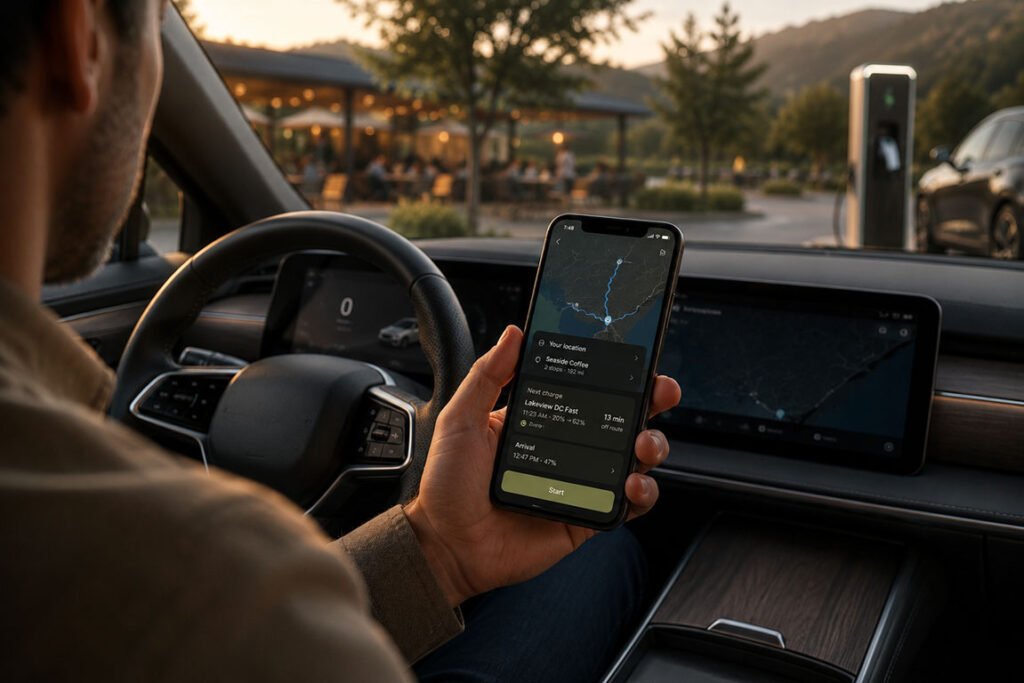
Driver using an EV charging app for route planning and charging status
What Makes Charging Less Boring?
This part matters more than people like to admit.
Charging is easier to tolerate when the cabin is comfortable, the climate control stays on, the screen gives you something useful to do, and the station is near a restroom, coffee shop, food, or decent lighting. App notifications help too, because they let the driver step away instead of hovering around the cable.
Tesla understands this with entertainment and app integration. Mercedes understands it through better station environments. The broader industry increasingly understands it through more useful station placement and stronger partnerships.
But entertainment is not a substitute for a good charging stop. A streaming app does not rescue a badly located charger. A nice screen does not fix poor safety, broken payment, or a useless location. A good charging experience is not just what happens inside the car. It is also where the charger is and what the driver can do while waiting.
Battery Swapping vs Fast Charging: Which Feels Better?
The better answer depends on infrastructure, region, vehicle ecosystem, and how the car is actually used.
| Comparison Area | Battery Swapping | Fast Charging |
|---|---|---|
| Waiting time | Usually much shorter where infrastructure exists | Still involves waiting, even when speeds are good |
| Infrastructure complexity | Very high | Easier to scale than swap stations |
| Vehicle compatibility | Limited to compatible vehicles | Works across many EV designs |
| Best use case | Dense urban markets, fleets, taxis, high-mileage use | Broad public use across many brands |
| Main weakness | Limited availability and expensive infrastructure | Reliability, congestion, price, and location quality vary |
| Ownership convenience | Excellent where network density is strong | More flexible overall, but inconsistent by network |
Battery swapping has clear advantages where the network is dense and the vehicle ecosystem is designed for it. Fast charging has the broader advantage of compatibility and scalability. Neither is a universal winner. The better ownership experience depends on what infrastructure actually exists around the driver, not on which idea sounds smarter in isolation.
Why Charging Convenience Matters More Than Peak Charging Speed
EV marketing often focuses on charging speed because it is easy to advertise. Ownership experience is different. Drivers remember failed sessions, broken chargers, confusing apps, crowded locations, and unreliable route planning far longer than they remember a peak charging number.
The strongest charging ecosystem is usually the one that feels predictable. Reliability, convenience, and simplicity often create more ownership satisfaction than a few extra minutes saved during an ideal charging session.
What Buyers Should Check Before Choosing an EV Based on Charging Experience
This is where charging convenience stops being abstract.
Check:
- Does the car have good built-in route planning?
- Does it precondition the battery before fast charging?
- Does it show reliable charger availability?
- Does the brand have access to a strong charging network?
- Does the car support Plug & Charge?
- Does the app show charging status clearly?
- Can you start and pay for charging easily?
- Are the chargers near your home, work, or regular routes reliable?
- Are charging locations safe and useful?
- Does the car offer enough real-world range to reduce charging stress?
- Is the charging experience good in your actual region, not just in marketing claims?
That last point matters most. The strongest charging ecosystem on paper may still be the wrong one for you if its best features are weak, absent, or overcrowded on the routes you actually drive.
For drivers without home charging, charging an EV without a garage is part of this decision, not a separate conversation. And when comparing home convenience against public charging friction, home EV charger options also becomes part of the picture.
Which Brands Currently Offer the Best Charging Experience?
A hard ranking would be too tidy for a category this dependent on region and infrastructure. But as an editorial snapshot, the current picture looks roughly like this:
| Brand / System | Strongest Charging Experience Advantage | Main Limitation |
|---|---|---|
| Tesla | Strongest integrated car-charger-app-payment ecosystem | Congestion and regional variation can affect the experience |
| NIO | Most interesting alternative through battery swapping where available | Swap infrastructure is heavily location-dependent |
| Rivian | Strong trip-focused ownership approach and app integration | Network coverage is still limited compared with Tesla |
| Mercedes-Benz | Premium charging hub strategy and stronger stop quality | Coverage matters more than branding |
| Ford | Network aggregation and Plug & Charge direction | Experience still depends heavily on third-party networks |
| Hyundai / Kia | Strong charging hardware and improving network integration, especially where IONITY access is strong | Regional support and compatibility vary |
Regional differences remain extremely important. A charging ecosystem that works exceptionally well in one country may feel completely different elsewhere depending on network coverage, pricing structures, roaming agreements, and local infrastructure maturity. Buyers should always evaluate charging experience in the context of their own market.
This is also where brand trust and charging trust start to overlap. If you want the wider ecosystem question, Tesla vs BYD reliability naturally here.
Final Verdict: The Best Charging Experience Is the One You Barely Notice
The best EV charging experience is not just the fastest charging speed. It is the system that removes friction from ownership.
Good route planning, reliable chargers, simple payment, Plug & Charge, useful app design, sensible locations, and strong network access matter at least as much as headline charging numbers. That is what makes charging feel easy, or at least ordinary enough that the driver stops planning their week around it.
For many buyers, Tesla still sets the benchmark for integrated charging. NIO shows how battery swapping can change the conversation where infrastructure exists. Rivian, Mercedes, Ford, Hyundai, and Kia are all trying to solve different parts of the same problem.
The smartest buyer should judge charging not by the brochure, the peak charging number, or the best-case demo stop, but by what charging looks like on their actual weekly routes, in their actual region, and inside their actual routine.
Charging Experience Is Becoming a Competitive Advantage
Charging experience is increasingly becoming a competitive advantage rather than a technical specification. As EV adoption grows, buyers are paying more attention to convenience, reliability, software quality, and charging-network integration instead of focusing only on charging speed.
FAQ
1. What is the best EV charging experience?
Usually the one that feels most predictable and least frustrating, not simply the one with the highest peak charging number.
2. Is Tesla still the best for charging convenience?
In many markets, yes. Tesla still offers one of the strongest integrated charging ecosystems, though congestion and regional differences matter.
3. Is battery swapping better than fast charging?
Sometimes. It can feel better where swap infrastructure is dense, but it is less widely available and harder to standardize across brands.
4. What is Plug & Charge?
It is a system where the car and charger handle authentication and payment automatically after you plug in, with no separate app or card needed when supported.
5. Do EV charging apps make charging easier?
They can, but only when they reduce friction. Too many apps, poor pricing clarity, or broken payment flows can make charging more annoying.
6. Should charging experience affect which EV I buy?
Absolutely. A good car with a weak charging ecosystem can feel worse to own than a less dramatic car with better-integrated charging support.