








Introduction
The Tesla Model 3 vs Hyundai Ioniq 6 comparison keeps returning because both cars sit at the heart of the electric sedan conversation: efficient, credible long-distance EVs with enough tech and polish to feel like more than simple commuters. Tesla still sets the tone for the segment in some areas, while Hyundai has become very good at building EVs that feel thoughtfully engineered rather than merely ambitious.
That is why this is not just another spec-sheet duel. The real question is which one makes more sense once you factor in daily usability, road-trip charging, interior quality, ride comfort, and long-term ownership. One of these cars still feels like the default answer for many EV buyers, while the other feels like the more characterful alternative.
If you want the wider market context before diving into this matchup, our electric car buying guide is the best place to start.
Exterior Design & Road Presence
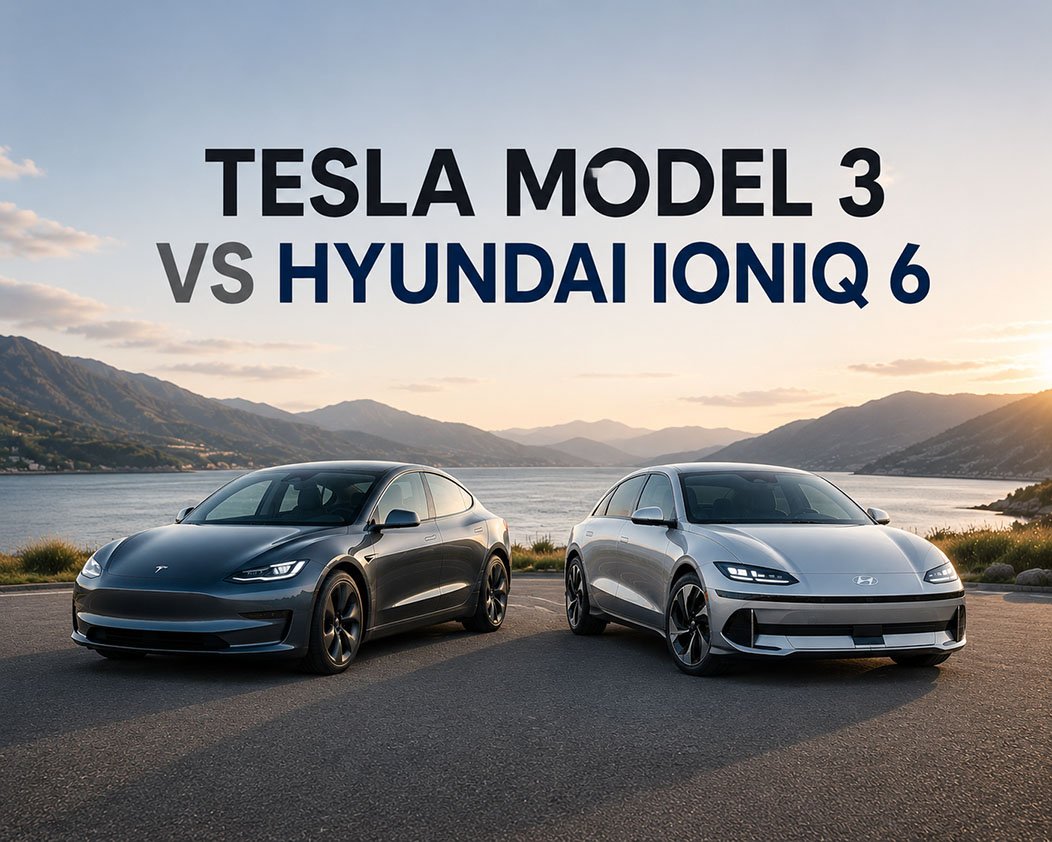
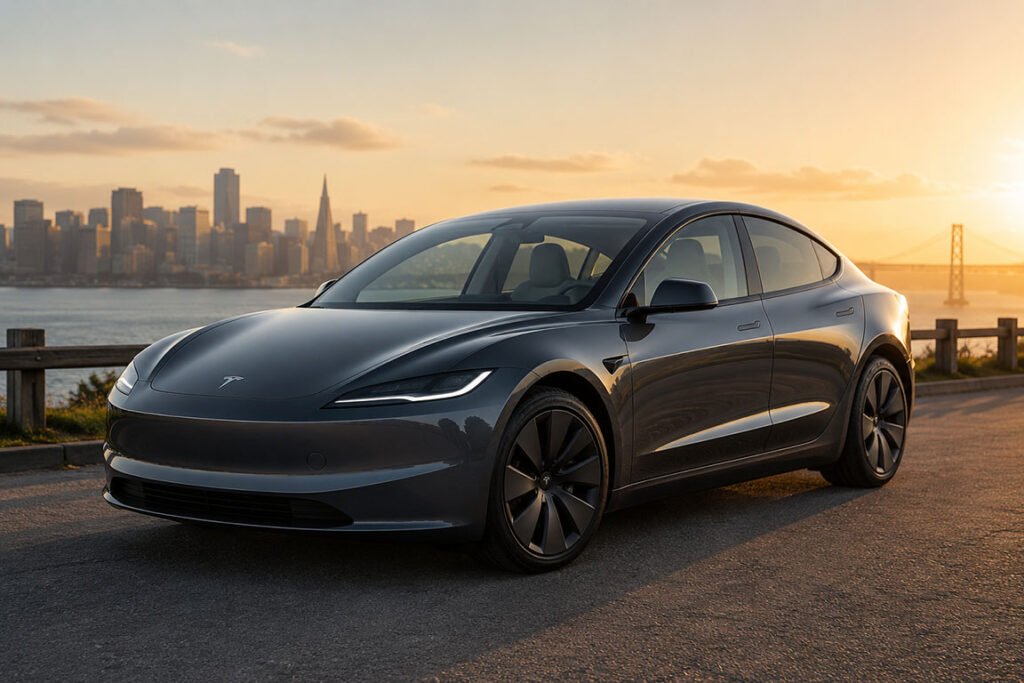
Tesla’s design has become so familiar that it almost risks feeling invisible. The Model 3 is clean, aerodynamic, and still quietly handsome, but it is no longer the kind of car that turns heads simply by being there. In 2026, that can be a strength or a weakness, depending on the buyer. It looks modern, but it also looks normal. That understated normality is part of Tesla’s appeal.
The Ioniq 6 goes the other way. Hyundai leaned hard into the streamliner idea, and the result is more distinctive, more futuristic, and more likely to draw comments in a parking lot. Crucially, the aerodynamic shape backs up the styling, which is not always the case when designers lean this hard into futurism. Hyundai’s own European material leans heavily on the car’s efficiency-led design, and that is fair.
Editor’s take: the Tesla is the more mature design if you value understatement. The Hyundai is the more memorable design if you want your EV to feel like a deliberate departure from the old sedan template. Neither looks cheap. The difference is that the Tesla feels cleaner and more restrained, while the Hyundai feels more individual and more expressive.
Interior Quality & Technology
This is where the comparison becomes more interesting. Tesla still believes in doing almost everything through the center screen, and the Model 3 remains one of the purest examples of that philosophy. Visually, it is elegant. In use, it can still feel like a car designed by people who trust software more than habit or muscle memory. That is fine when the interface is quick. It is less charming when you are trying to do something simple on the move.
The Ioniq 6 takes a more balanced approach. It is still modern and still screen-heavy, but Hyundai keeps more of the cabin logic familiar. That makes the Ioniq 6 easier to settle into from the first drive. The Ioniq 6 cabin does not look as radically minimalist as the Tesla’s, yet for many drivers it feels more natural to live with. Hyundai also gives the interior a stronger sense of mood. It feels designed, not stripped down.
Material quality is also one of the areas where Hyundai lands a few clean punches. The Model 3 cabin has improved, and recent revisions made it feel more solid and more polished than older versions. Still, the Ioniq 6 tends to feel slightly warmer and more tactile, while the Tesla still leans on simplicity more than richness. That does not make the Tesla bad. It just means the Hyundai feels more conventionally premium.
If you are the kind of driver who wants the cleanest interface and likes the idea of the car feeling like a piece of consumer tech, the Tesla still makes sense. If you want a cabin that feels modern without turning every routine task into an exercise in screen management, the Hyundai is easier to recommend.
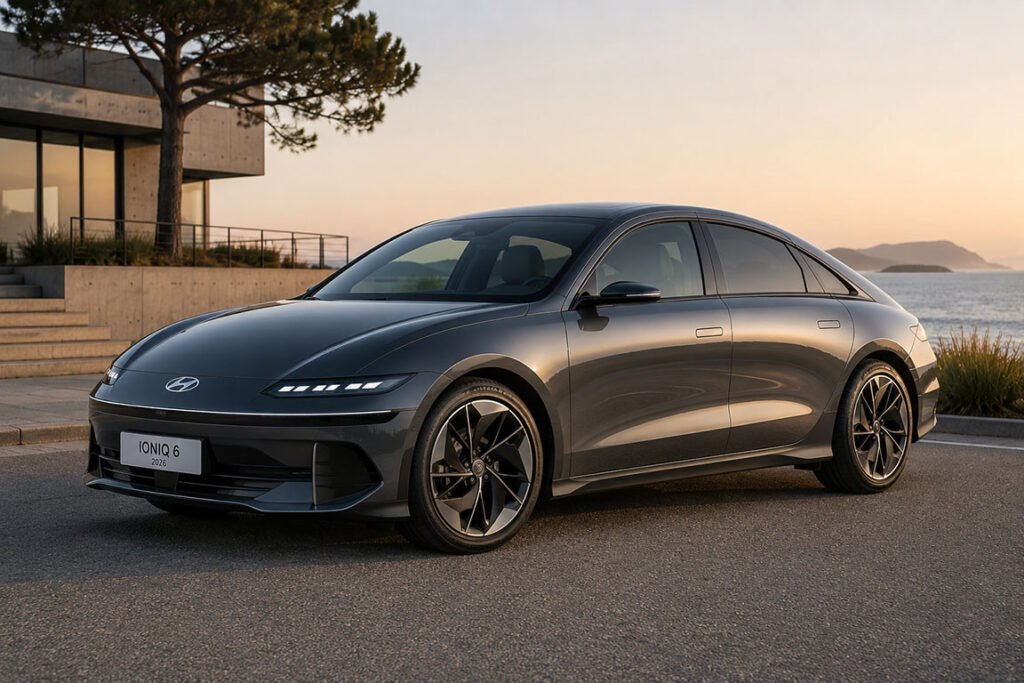
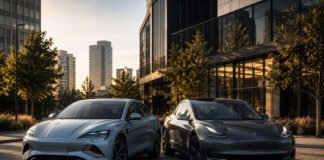
The Ioniq 6 looks more futuristic and more distinctive than the Tesla, with a shape that prioritizes aerodynamic efficiency as much as visual identity.
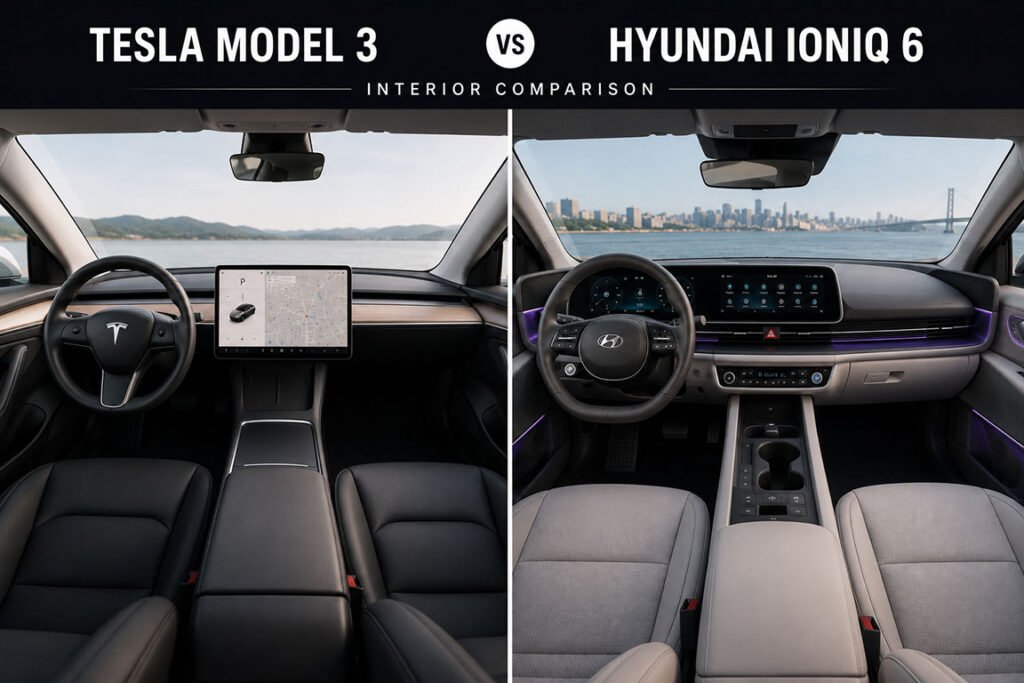
Tesla and Hyundai take very different approaches inside, with the Model 3 built around radical simplicity and the Ioniq 6 offering a richer, more layered cabin experience.
Driving Experience
This is the section that matters most, because many buyers come to this comparison expecting the Tesla to walk away with it.
The Model 3 still feels like the sharper car. It responds quickly, changes direction cleanly, and has the kind of directness that makes it feel light on its feet. Even in non-performance trims, there is an immediacy to the Tesla that helps it feel more alive than many EVs. That matters if you still care about driving rather than just operating a machine efficiently.
The Ioniq 6 is not slow, and in daily driving it is more than quick enough, but it approaches the job from a different angle. It feels calmer. More settled. Less eager to show off. Hyundai’s official material talks about sporty performance and excellent driving dynamics, but the car’s real strength is composure rather than excitement. It makes a better first impression on a long journey than on a short blast down a back road.
Ride comfort is where the Hyundai usually feels like the grown-up choice. The Model 3 is the more agile car, but the Ioniq 6 is often the more relaxed one. On rougher surfaces, that matters. The Hyundai feels like it was tuned by people who expected owners to spend real time in it, not just admire its efficiency scores.
Refinement follows a similar pattern. Both cars are quiet by normal standards, but the Ioniq 6 often feels more soothing at speed. The Tesla is still the more alert and more engaging sedan. The Hyundai is the one that better understands that an EV sedan should also be a very good cruiser.
If you want the more driver-focused experience, take the Tesla. If you want the more comfortable and more relaxed sedan, take the Hyundai. That is the clearest summary of the whole dynamic.
For a useful real-world look at long-distance driving and efficiency, this highway comparison video is worth watching before the range section below.
Range & Efficiency
This is where both cars make a strong case, but in slightly different ways.
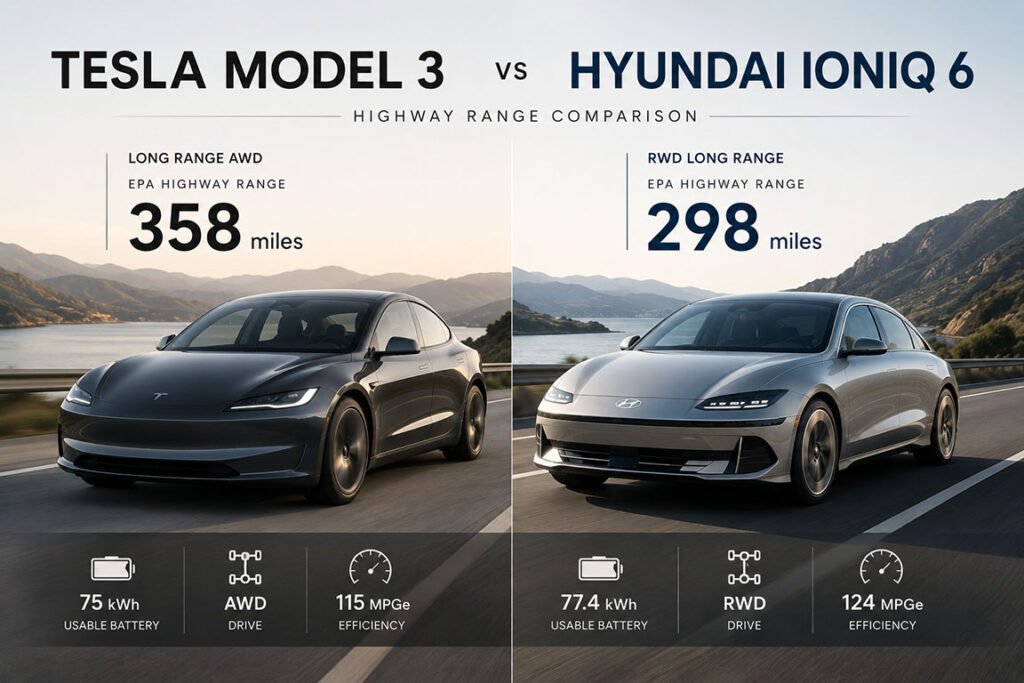
Tesla’s official U.S. Model 3 page lists up to 195 miles added in 15 minutes of charging, depending on version. EV Database’s 2026 Premium RWD listing also estimates about 360 miles of range with combined energy consumption around 219 Wh/mile. The AWD version is estimated at about 340 miles with 232 Wh/mile. Those are still strong numbers, and they reinforce Tesla’s reputation for efficiency.
According to the Tesla official Model 3 specifications, the latest Model 3 lineup still sets a strong benchmark for range and charging performance in this class.
Hyundai’s official European figures for the new Ioniq 6 quote up to 680 km of range with the 84 kWh long-range RWD version. EV Database’s MY26 84 kWh RWD entry shows a real-world range estimate between 395 and 785 km depending on conditions, with 635 km combined in mild weather and 520 km highway in mild weather. That is excellent, and it confirms what the Ioniq 6 has done well since launch: cover distance with very little drama.
Hyundai official Ioniq 6 range and charging details also show why the car remains one of the most technically impressive long-distance EV sedans on sale.
In simple terms, the Tesla still feels like the efficiency specialist, especially if you care about how economically it uses energy in mixed conditions. The Hyundai feels like the car with the more impressive long-distance serenity, especially in long-range rear-wheel-drive form. Both are good. The Ioniq 6 just makes its case more quietly.
Charging Speed & Daily Usability
This section is the real fork in the road.
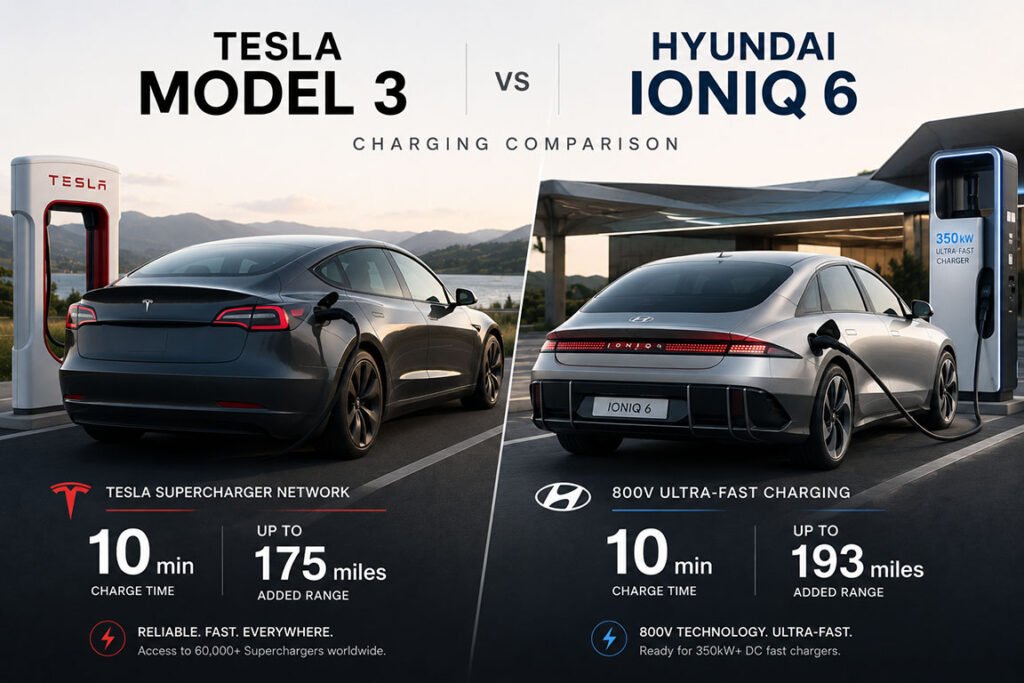
The Tesla Model 3 still benefits from the Supercharger ecosystem. Tesla says the global Supercharger network now exceeds 80,000 stalls, and the user experience remains one of its biggest ownership advantages: navigate, plug in, and charge with minimal friction. That convenience is still very hard to ignore if you road-trip regularly.
The Hyundai Ioniq 6, though, has an excellent technical answer. Hyundai’s 800V system allows the Ioniq 6 to add up to 426 km in 15 minutes and supports very fast charging when the right hardware is available. In pure charging-performance terms, the Hyundai is deeply impressive. In network-convenience terms, Tesla still has the edge.
That is the heart of it. The Ioniq 6 may be the more advanced charging machine on paper. The Model 3 is often the easier charging car in practice, especially in markets where Tesla’s network is dense and reliable.
For daily home charging, both are straightforward enough. For road-trip ease, the Tesla still feels like the more complete system-level answer. If you want a wider cost picture, our EV charging cost guide is worth reading here, and for another Tesla-led charging/value matchup, our Tesla vs BYD comparison is also useful.
Real-World Ownership Costs
Charging costs depend mostly on where you live, how often you fast-charge, and whether you can charge at home. That much is straightforward. The more interesting difference is how each car feels as a long-term ownership proposition.
Tesla still tends to hold value well because demand remains strong, the charging ecosystem is familiar, and the Model 3 has become a reference point in the used EV market. Tesla’s UK warranty also gives Model 3 RWD buyers 8 years or 100,000 miles of battery and drive-unit cover with a minimum 70% retention threshold, while longer-range and performance versions get 8 years or 120,000 miles under Tesla’s current support structure.
Hyundai counters with a strong warranty story of its own. Hyundai Europe highlights an 8-year battery warranty and 160,000 km coverage on electrical battery units for the Ioniq 6, alongside the broader 5-year unlimited-mileage vehicle warranty in Europe. That does not settle resale-value arguments on its own, but it does strengthen the ownership case.
Maintenance on both should be manageable by EV standards. Insurance, however, is where the answer becomes market-specific quickly, so sweeping claims are pointless. The more honest editorial conclusion is this: the Tesla often makes the stronger ecosystem-and-resale case, while the Hyundai makes the stronger comfort-and-warranty reassurance case. Which matters more depends on the buyer.
Pros and Cons
Tesla Model 3 Pros
- Excellent efficiency
- Sharp, responsive driving character
- Supercharger ecosystem remains a major advantage
- Strong software integration
- Feels like the more engaging car to drive
Tesla Model 3 Cons
- Cabin minimalism can become annoying in daily use
- Ride comfort is not as settled as the Hyundai’s
- Interior still prioritizes simplicity over warmth
- Familiar design no longer feels especially fresh
- Premium feel depends more on tech than material richness
Hyundai Ioniq 6 Pros
- Distinctive, futuristic exterior design
- More comfortable long-distance ride
- Strong charging performance on 800V hardware
- Cabin feels more conventionally premium
- Excellent long-range credibility in RWD form
Hyundai Ioniq 6 Cons
- Styling will not appeal to everyone
- Public charging experience depends more on third-party infrastructure
- Less playful to drive than the Tesla
- Rear packaging is shaped by the design more than by pure practicality
- Less intuitive than Tesla’s ecosystem once you are already inside it
Which EV Is Better for Different Drivers?
For city users, the Tesla Model 3 is the easier recommendation if you value quick responses and a more compact-feeling, agile car. The Hyundai is still easy enough, but it feels more like a distance machine than a city specialist.
For technology enthusiasts, the Tesla remains the obvious answer. Its interface-first character, software integration, and ecosystem advantage still make it feel like the more complete tech product.
For long-distance drivers, the Ioniq 6 deserves serious respect because its efficiency and ultra-fast charging capability are excellent. But the Tesla still has the stronger overall road-trip argument if the Supercharger network is relevant in your region. In the real world, that convenience matters more than charging speed on paper.
For family users, the Hyundai is the more sensible choice. It is calmer, more comfortable, and feels less tiring over time. It also has a cabin layout that most drivers will adapt to more quickly.
For first-time EV buyers, the better answer depends on personality. If you want the most established EV ownership experience, buy the Tesla. If you want something that feels more traditional, more comfortable, and less defined by a software-first experience, buy the Hyundai.
Final Verdict: Tesla Model 3 or Hyundai Ioniq 6?
If the question is which one is the stronger all-round electric sedan, the answer is still the Tesla Model 3. It remains the sharper car, the stronger ecosystem play, and the easier recommendation for buyers who want the most complete EV ownership package rather than simply the nicest cabin or the most unusual design.
But if the question is which one feels more mature, more comfortable, and more rewarding to live with as a conventional premium sedan, the Hyundai Ioniq 6 makes a very serious case. It is the better fit for drivers who care more about long-distance comfort, cabin atmosphere, and everyday ease than about Tesla’s software-first identity.
So the clean conclusion is this:
Choose the Tesla Model 3 if you want the more complete EV ecosystem, stronger efficiency identity, and a more engaging drive.
Choose the Hyundai Ioniq 6 if you want the more comfortable, more distinctive, and more quietly premium electric sedan.
If you still want broader context before deciding, read our best affordable EVs roundup and our Tesla Model 3 review before making the final call.